
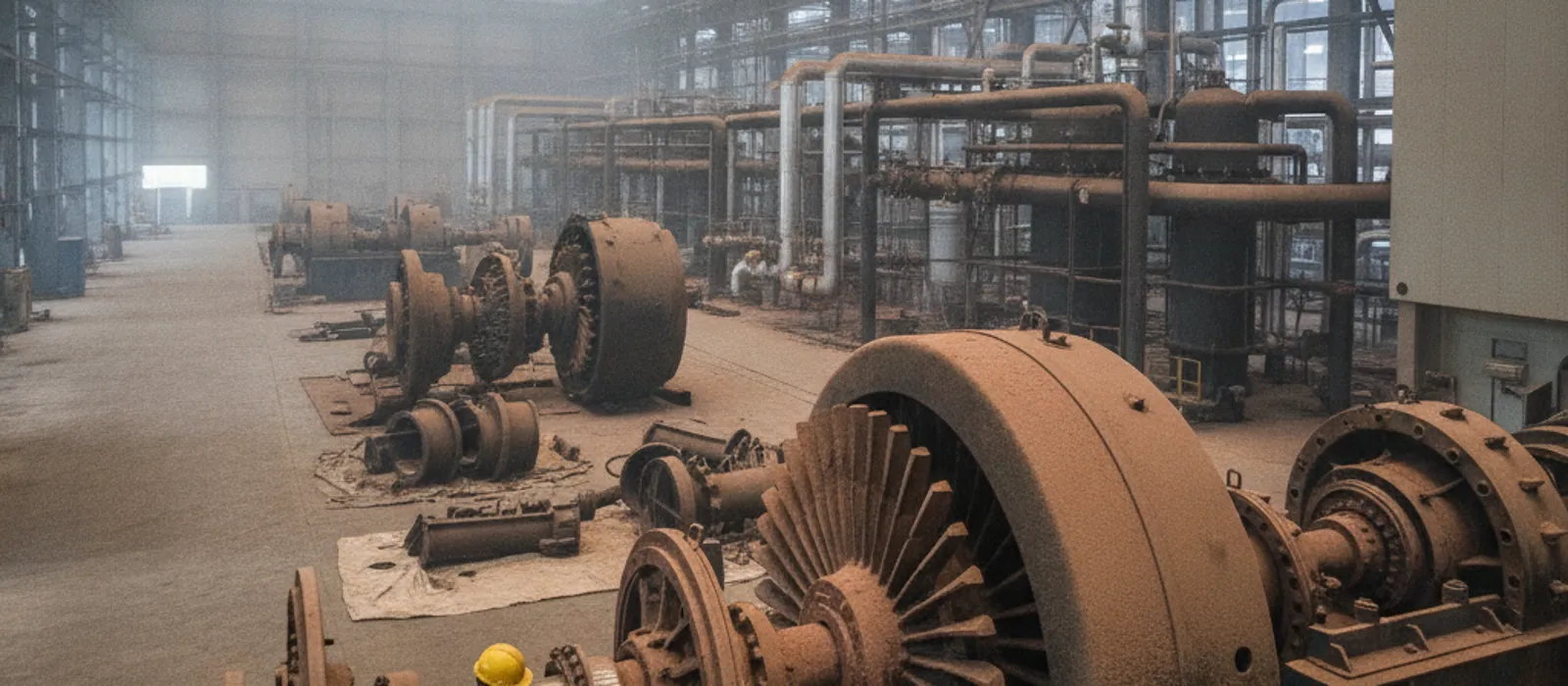
A prime-rated set that carried 900 kW comfortably in October starts shedding load at 780 kW in January, and nobody changed the process, the fuel supplier or the load list. The plant manager is told the machine is “getting old”. It is not old. It is derated.
The harmattan dust effect on turbines and generators is the most under-budgeted line item in Nigerian plant operations, because it does not announce itself with a trip or an alarm. It arrives as a slow loss of available megawatts, a rising fuel bill per kWh and a maintenance interval that quietly stopped being adequate. By the time the machine trips, you have already paid for the derating twice.
Where the harmattan dust effect on turbines and generators begins
Every gas turbine and every diesel generator is an air-breathing machine. A 5 MW class industrial gas turbine swallows in the region of 18 to 20 kg of air per second at full load. Whatever is suspended in that air goes through the compressor.
Harmattan dust is not ordinary dust. The Saharan and Sahelian material carried south on the north-east trades between roughly November and February is dominated by quartz and clay minerals, with a large fraction below 10 microns. The World Meteorological Organization’s work on sand and dust storms describes how these particles stay airborne long enough to cross continents. Long-range transport is precisely why the fine fraction reaches your inlet even in Lagos, hundreds of kilometres from any source region.
That size distribution matters, and it splits the damage into two mechanisms.
Fouling is deposition on compressor aerofoils. Fine particles, helped by oil mist and residual humidity, build a film that changes the blade profile and roughens the surface. Compressor efficiency falls, mass flow falls, and output follows. With adequate filtration, fouling commonly costs 3 to 6 percent of output before a wash, and considerably more without it. Fouling is recoverable by washing.
Erosion is mechanical removal of blade material by coarser particles that get past the filter. Quartz sits at about 7 on the Mohs scale, harder than the coating on most compressor blades. It blunts leading edges, opens tip clearances and roughens surfaces permanently. Washing does not recover it. Only blade repair or replacement at overhaul does, which is a different order of cost and needs an outage window.
Filtration decides which of the two you get. A plant running a coarse panel filter through harmattan is not saving money, it is converting a recoverable loss into a permanent one.
If your available output has moved and you do not know which mechanism is responsible, request a technical proposal for a performance baseline before the next dry season. Measuring first is cheaper than washing a machine whose losses are already mechanical.
Heat: what ambient temperature does to your nameplate
Nameplate ratings are quoted at reference conditions that do not exist in Nigeria. Gas turbines are rated at ISO conditions of 15 degrees C, 101.325 kPa and 60 percent relative humidity. Reciprocating engine ratings follow a different reference basis, typically 25 degrees C and near sea level.
A gas turbine is a constant volume flow machine. As inlet air temperature rises, density falls, mass flow falls and output falls with it. The usual working figure for industrial machines is a loss of 0.5 to 0.9 percent of output per degree C above 15 degrees C, with heat rate worsening at the same time. At a 33 degree C afternoon inlet temperature, that is roughly 9 to 16 percent off the nameplate before you account for anything else.
Diesel and gas engine sets behave differently but are not exempt. Most manufacturers publish no derate up to a stated ambient and site elevation, then apply a schedule above it. Published curves commonly sit in the range of 2 to 4 percent per 5 degrees C above the rated ambient, plus roughly 1 percent per 100 m of elevation above the rated site height. Do not use those as design numbers. Use the derating curve for your specific engine and alternator combination, because the spread between manufacturers is wide.
Elevation compounds the problem inland. A set specified for a Lagos site and later moved to Kaduna at roughly 645 m loses something in the region of 6 percent of output to altitude alone, before ambient temperature is considered. This is one of the most common causes of a “faulty” generator that is in fact working exactly as physics requires. We cover the diagnostic sequence in more detail in generator low output causes.
Harmattan makes the heat picture more complicated, not simpler. Daytime dust haze can suppress peak temperature, while nights become sharply colder. The swing is what strains the machine: thermal cycling on gaskets, exhaust bellows and turbocharger housings, and condensation risk on windings at dawn.
Humidity, salt and the end of the dry season
South of the Niger, and particularly in Rivers and Lagos, relative humidity above 80 percent is normal for much of the year. Humid air is slightly less dense than dry air at the same temperature, so there is a small output effect, but the real damage from humidity is chemical and electrical rather than thermodynamic.
Coastal and delta sites take in salt aerosol alongside dust. Salt is hygroscopic. It absorbs moisture from humid air, forms a conductive film and accelerates hot corrosion on turbine hot section components and pitting on compressor blades. Inlet filtration specified for dust alone will not deal with salt at a coastal site. Coalescing or moisture separation stages have to be part of the design.
The most expensive week of the year for alternators is usually the first week of rain after harmattan. Dust that has accumulated on stator and rotor windings through the dry season absorbs moisture, becomes conductive and produces tracking, low insulation resistance and earth faults on the first start under load.
IEEE 43 sets out the recommended practice here. For random-wound stator windings rated below 1 kV, a minimum insulation resistance of 5 megohms corrected to 40 degrees C is the usual acceptance threshold, and the polarisation index tells you whether the winding is merely damp or genuinely contaminated. A machine reading 2 megohms in March is not a machine you energise and hope.
Anti-condensation heaters exist for exactly this reason and are frequently found switched off or failed. Checking them is a ten minute job in November that prevents a rewind in April.
Three hypothetical scenarios and what the derating costs
The figures below are illustrative and hypothetical. Your own numbers will differ with site conditions, load factor and fuel contract.
Hypothetical example: a 1,250 kVA prime set running two shifts. Average load 600 kW, 16 hours a day, 26 days a month, so about 249,600 kWh a month. Specific fuel consumption drifts from 0.28 to 0.31 litres per kWh across December and January as air filter restriction climbs and a dust blanket on the radiator core cuts heat rejection, forcing the controller to derate. The extra 0.03 litres per kWh is 7,488 litres a month, which you can price at your own delivered diesel rate, before the two load-shed events per shift that cost production throughput. A two-stage pre-cleaner, a halved filter interval for December to February and weekly radiator blowdown removes most of it.
Hypothetical example: a 5 MW class gas turbine in cogeneration service. At a 33 degree C inlet, the machine is already down to about 4.37 MW on ambient alone. Loaded filters add roughly 40 mm water gauge of inlet pressure drop above clean condition, costing a further 0.5 percent or so, and compressor fouling takes another 3 percent. Available output sits near 4.2 MW against a 5 MW ISO rating. An offline crank wash in a 10 hour window recovers close to 2.6 percent. Across 3,000 hours of dry season running, that recovered energy displaces a substantial value of diesel generation that would otherwise have covered the shortfall. The arithmetic on a wash is rarely close.
Hypothetical example: two 500 kVA standby sets. Both sit idle through harmattan with the anti-condensation heaters unpowered. On the first wet-season call, one set fails to hold load and trips on earth fault. Insulation resistance measures 2 megohms. Cleaning, drying and retesting comes to a modest sum and a short turnaround. Had the winding flashed over, a full rewind would have cost several times more, with an eight to ten week lead time on the core.
| Measure | Typical scope | What it addresses | Caveat |
|---|---|---|---|
| Genset inlet upgrade | Cyclonic pre-cleaner plus panel filter, per set | Erosion, filter restriction | Needs airflow re-check; do not restrict the engine |
| Radiator clean and fin comb | Pressure wash, comb, per set | Heat rejection, thermal derate | Monthly during harmattan, not annually |
| Alternator clean, dry, IR and PI test | Per machine, offline | Tracking, earth faults | Requires the machine out of service |
| Anti-condensation heater retrofit | Per machine | Winding moisture | Must stay energised when the set is off |
| GT offline crank wash | 5 MW class, 8 to 12 hour outage | Compressor fouling | Outage window and qualified crew required |
| Self-cleaning pulse filter house | GT inlet retrofit | Fouling and erosion | Design must suit site dust loading |
| Borescope inspection | Hot section and compressor | Erosion, coating loss | Findings may open unplanned scope |
These measures need a site survey to scope and cost properly. Filter house design in particular depends on measured dust loading, and specifying it from a catalogue is how plants end up with the wrong pressure drop.
Controlling harmattan dust on turbines and generators: filtration, washing and intervals
Three decisions carry most of the benefit.
Filtration class. Gas turbine inlets in dusty environments generally need a staged arrangement: a coarse pre-filter or weather hood, a medium stage, and a fine final stage. Modern general ventilation filters are classified under ISO 16890 rather than the older EN 779 grades, and the fine fraction of harmattan dust is exactly what the coarse classes miss. Static filter houses suit moderate loading. Self-cleaning pulse systems make sense where dust loading is genuinely high and access for element changes is poor, but they carry a higher capital cost and their own maintenance burden.
Inlet pressure drop as a monitored parameter. Every 25 mm water gauge of additional inlet pressure drop costs a gas turbine roughly 0.35 percent of output and adds to heat rate. If you are not trending differential pressure across the filter house, you are changing elements either too early, which wastes money, or too late, which wastes fuel. On engine sets, restriction indicators on the air cleaner do the same job for a fraction of the cost and are frequently ignored.
Seasonal intervals. Manufacturer intervals are written for reference conditions. A December to February interval of half the published figure for air filters, and monthly rather than annual radiator cleaning, is a reasonable starting position for most Nigerian sites. Then measure, and adjust to what the machine actually shows. Our guidance on setting these in a structured way is in turbine inspection intervals.
One caution on inlet cooling. Evaporative cooling and fogging can recover a useful share of ambient losses, but only where there is wet bulb depression to work with. In Lagos or Port Harcourt at 85 percent relative humidity, the achievable gain is small and the added moisture carries its own risk. During harmattan in the north, when relative humidity can fall below 25 percent, the potential is much larger, but that is also when the air is dirtiest and water treatment becomes critical. Mechanical chilling holds a set inlet temperature in any weather and carries a parasitic load. There is no free option here, and anyone quoting one has not done the psychrometrics for your site.
To size any of this properly, book a plant assessment. A measured dust loading and a performance baseline are what separate a specification from a guess.
Planning the outage window and the budget
Derating is a budgeting problem before it is an engineering problem. The recoverable losses, fouling and restriction, should be attacked during the dry season while the machine is running or in short opportunity windows. The non-recoverable losses, erosion and hot section deterioration, belong in your overhaul planning and need a proper outage, specialist tooling and qualified engineers on site.
The sequence that works: baseline performance before harmattan, trend inlet differential pressure and specific fuel consumption weekly through it, borescope after it, then decide scope. Deciding scope first and measuring afterwards is how plants buy filter houses they did not need and skip blade work they did.
Fuel cost per kWh is the number that makes the case internally, and it is worth calculating properly rather than assuming. We set out the method in diesel generator cost per kWh.
For routine dry season care of engine-driven sets, see generator maintenance in Nigeria. Where the question is whole-plant availability and heat rate rather than a single machine, a power plant audit will quantify what the environment is costing you across the fleet. Where blade condition, balance or bearing wear is suspected, that falls under rotating equipment services. Performance testing to a recognised basis, such as the relevant ASME codes and standards, gives you numbers you can put in front of a board.
Frequently Asked Questions
How much output does harmattan dust actually cost a gas turbine?
Compressor fouling from airborne dust typically costs 3 to 6 percent of output on a machine with adequate filtration, and considerably more where filtration is poor or elements are overdue. That is separate from ambient temperature losses, which are usually larger. The only way to know your figure is to trend output at corrected conditions and compare against a clean baseline.
Can I just wash the compressor more often instead of upgrading filtration?
Washing recovers fouling losses but does nothing for erosion, and erosion is what coarse filtration allows. Frequent washing on a poorly filtered machine treats the symptom while the blade profiles continue to degrade permanently. Washing also consumes outage time for offline crank washes, which has its own production cost.
Why do my standby generators fail on the first rain after harmattan?
Dust accumulated on the windings through the dry season absorbs moisture as humidity returns, becomes conductive and causes tracking or earth faults on the first start under load. Anti-condensation heaters that are switched off or failed are the usual root cause. Test insulation resistance and polarisation index before the season changes, not after a failure.
Should I derate my generator specification for a northern Nigerian site?
Yes, and for two separate reasons: ambient temperature and site elevation. Use the manufacturer’s published derating curve for your specific engine and alternator rather than a rule of thumb, because the spread between makes is significant. A set sized on nameplate for a Kaduna or Kano site will run out of capacity on the hottest afternoons of the year, which is precisely when your load is highest.