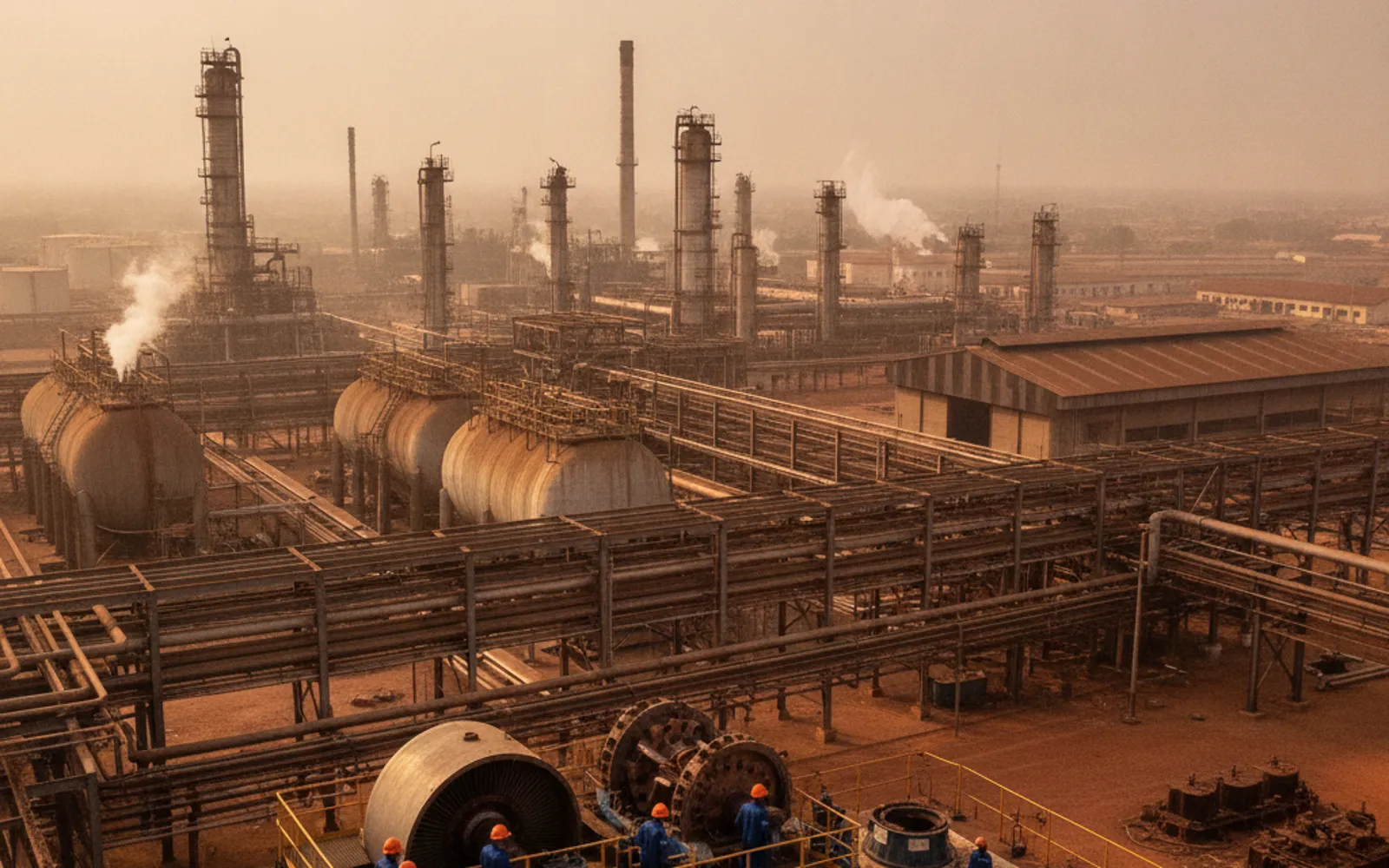
Kaduna plants run steam turbine drives, compressor trains and standby generation that has to survive harmattan dust, high dry season ambients and an unreliable grid. We overhaul, test and hand that equipment back inside an agreed outage window.
Kaduna is the industrial anchor of northern Nigeria, and the installed equipment base reflects that history. Steam turbine drives and compressor trains sit in the refining and petrochemical complex on the southern side of the city, boiler houses and process drives survive from the textile era, and almost every mill, factory, hospital and commercial site around the Kakuri and Kudenda industrial areas carries standby generation. Much of that plant is old, well built and still serviceable, provided somebody inspects it on a schedule instead of after it trips.
Axiom Power Services covers Kaduna State from our Lagos base with steam turbine overhaul, gas turbine inspection, industrial generator maintenance and rotating equipment services. We do not price an overhaul off a phone call. Work starts with measurement: vibration signatures, lube oil condition, alignment and thermal growth records, run hours since the last hot gas path or major inspection, and the condition of the governor and trip system. That produces a scope your procurement team can compare line by line, with spares lead times stated separately from labour.
Kaduna's refining, petrochemical and process plants depend on back pressure and condensing turbines driving pumps, blowers and compressors, often with no OEM support left behind them. We cover rotor removal, blade and diaphragm inspection, gland and seal renewal, bearing changeout, dynamic balancing, lube oil flushing to a stated cleanliness class, and overspeed trip testing before handback.
Dust loading across Kaduna during harmattan drives inlet filter differential pressure and compressor fouling well past anything a coastal duty cycle would predict. We carry out borescope inspections, combustion and hot gas path work, inlet filtration upgrades, and online and offline compressor washing tied to your own run hours and performance trend rather than a generic calendar.
Grid supply in Kaduna State makes standby and prime rated sets a production asset rather than an emergency item, and most failures show up as fuel, cooling or excitation problems long before the engine itself is at fault. We service sets from 100 kVA upward, covering AVR and governor faults, insulation resistance and polarisation index testing on windings, fuel polishing and tank cleaning, cooling system work and resistive load bank testing at site.
Pumps, fans, centrifugal and reciprocating compressors and gearboxes across Kaduna's mills, process plants and fabrication shops usually fail at the coupling, the bearing or the seal, not at the driver. We provide laser shaft alignment with thermal growth compensation, vibration analysis against ISO 20816 velocity bands, in situ and workshop dynamic balancing, and mechanical seal replacement.
Kaduna grew as a rail and administrative centre and then as one of Nigeria's first planned industrial cities, which is why so much heavy plant sits inside a short drive of the city. The refining and petrochemical complex to the south, the industrial estates at Kakuri and Kudenda, vehicle assembly, flour milling, chemicals and fertiliser production, and a long standing heavy engineering and fabrication base are all served by the same small pool of maintenance capacity. Rehabilitation activity around the refinery has pulled turbine, compressor and control system demand back up across the state, and that competition for skilled outage labour is now a real scheduling constraint.
The technical consequence of an old industrial base is mixed vintage machinery and spares obsolescence. Plenty of turbines and pumps in Kaduna are still running on mechanical hydraulic governors, analogue protection and drawings that no longer match the machine after decades of patch repairs. Our approach is dimensional inspection and as found documentation before anything is ordered, so that a bearing, a seal face or a diaphragm segment can be manufactured to measured dimensions rather than to a parts list that no longer applies. Where a governor or trip system cannot be supported any longer, we scope a digital electronic governor and independent overspeed protection instead of chasing obsolete parts.
None of that is guesswork. A plant audit establishes the baseline: which machines are critical to production, what their current condition and vibration signature actually is, what is on the shelf, and what has no replacement path at all. From that you get a spares criticality register and a defensible maintenance budget instead of a series of emergency purchase orders.
Kaduna sits roughly 600 metres above sea level, well above the coastal plants in Lagos and Port Harcourt, and dry season ambient temperatures regularly reach the mid to high 30s Celsius in March and April. Both factors reduce inlet air density, and both gas turbines and diesel gensets derate accordingly. Manufacturer derate curves typically begin to bite above 500 metres and above 25 to 30 degrees Celsius, so a set with a 1,000 kVA nameplate at ISO conditions will not deliver 1,000 kVA in Kaduna in April. If your load calculation was done off the nameplate, you are already closer to the limit than the paperwork suggests.
Harmattan, from roughly December to February, is the other Kaduna specific load on rotating plant. The fine Saharan dust it carries is abrasive and gets everywhere, and the effects are predictable:
The practical answer is to run the schedule around the season rather than against it. That means trending filter differential pressure and output instead of changing elements on a calendar, shortening compressor wash intervals through the dust months, sealing or pressurising control panels, and doing insulation resistance and polarisation index testing plus thermography before and after harmattan. Intrusive work and generator servicing are best placed outside the dust window, with radiator and cooler cleaning immediately after it.
Kaduna is about 200 km from Abuja by road and rail, and roughly 750 km from our Lagos base. Engineers and light diagnostic tooling can be on site within a day or two of an agreed scope, while load banks, lifting gear and heavy tooling move by road and have to be written into the plan rather than assumed. Kaduna also has an inland dry port, which matters more than most people expect: imported spares can be manifested to Kaduna and cleared there instead of being trucked up from Apapa, and on a critical path that can save days. We also cover the neighbouring hubs at Abuja and Kano, so crews and tooling can be shared across a northern campaign.
Lead time, not labour, is what usually decides whether an outage lands on schedule. Blades, diaphragm segments, journal and thrust bearings, mechanical seals, governor components and control cards are commonly 6 to 16 weeks on import, which is why we push for a pre-outage inspection 8 to 12 weeks before the window opens. That inspection is what converts a guess into an order. Non critical items such as sleeves, shafts and simple housings can often be machined locally in the Kaduna and Zaria engineering workshops, and we will say plainly in the proposal which parts leave site and which do not.
Price the outage against the cost of the downtime it prevents, not against the invoice on its own. A condition assessment is quoted per train and typically falls between ₦1.5m and ₦5m (roughly $1,000 to $3,200) depending on how many machines are in scope and whether vibration and oil analysis are included; overhaul pricing depends entirely on the as found condition and the spares scope. Our maintenance cost guide sets out how each element is built up. To start, request a technical proposal or book a plant assessment on +234 803 000 0000.
For diagnostics, breakdown attendance or a condition survey, engineers can normally be in Kaduna within 24 to 48 hours of an agreed scope, travelling through Abuja. Heavy items such as load banks, lifting equipment and workshop tooling move by road from Lagos and need 2 to 3 days, so those are scheduled rather than promised on demand. For a planned outage we prefer to be on site for a pre-inspection well ahead of the window so that long lead spares are already ordered.
It depends on the finding. Bearing changeout, gland and seal renewal, alignment and in situ balancing are done at your plant, and low speed balancing of smaller rotors can be handled at capable workshops in the north. Blade repair or replacement, welded rotor repairs and high speed balancing require a specialist facility, and that transport and queue time is the main driver of outage length. We state in the proposal exactly which components are expected to leave site and what that adds to the schedule.
It shortens them, but not uniformly. Filter changes and compressor washes should be driven by differential pressure and performance trend through December to February rather than by a fixed calendar, because dust loading in a given year varies. We also recommend insulation resistance and polarisation index testing on alternator windings, plus radiator and cooler cleaning, immediately after the season, and placing intrusive overhaul work outside the dust window where the production plan allows.
Yes, and that is the sensible way to do it. We work to a scope frozen ahead of the window, with long lead spares ordered against a pre-outage inspection, shift working where the critical path requires it, and daily progress reporting against the agreed milestones. Handback includes test records: alignment readings, balancing certificates, lube oil cleanliness, insulation test results and overspeed trip verification, so the plant is signed back over on evidence rather than on assurance.
Written technical proposals. Outage support available.