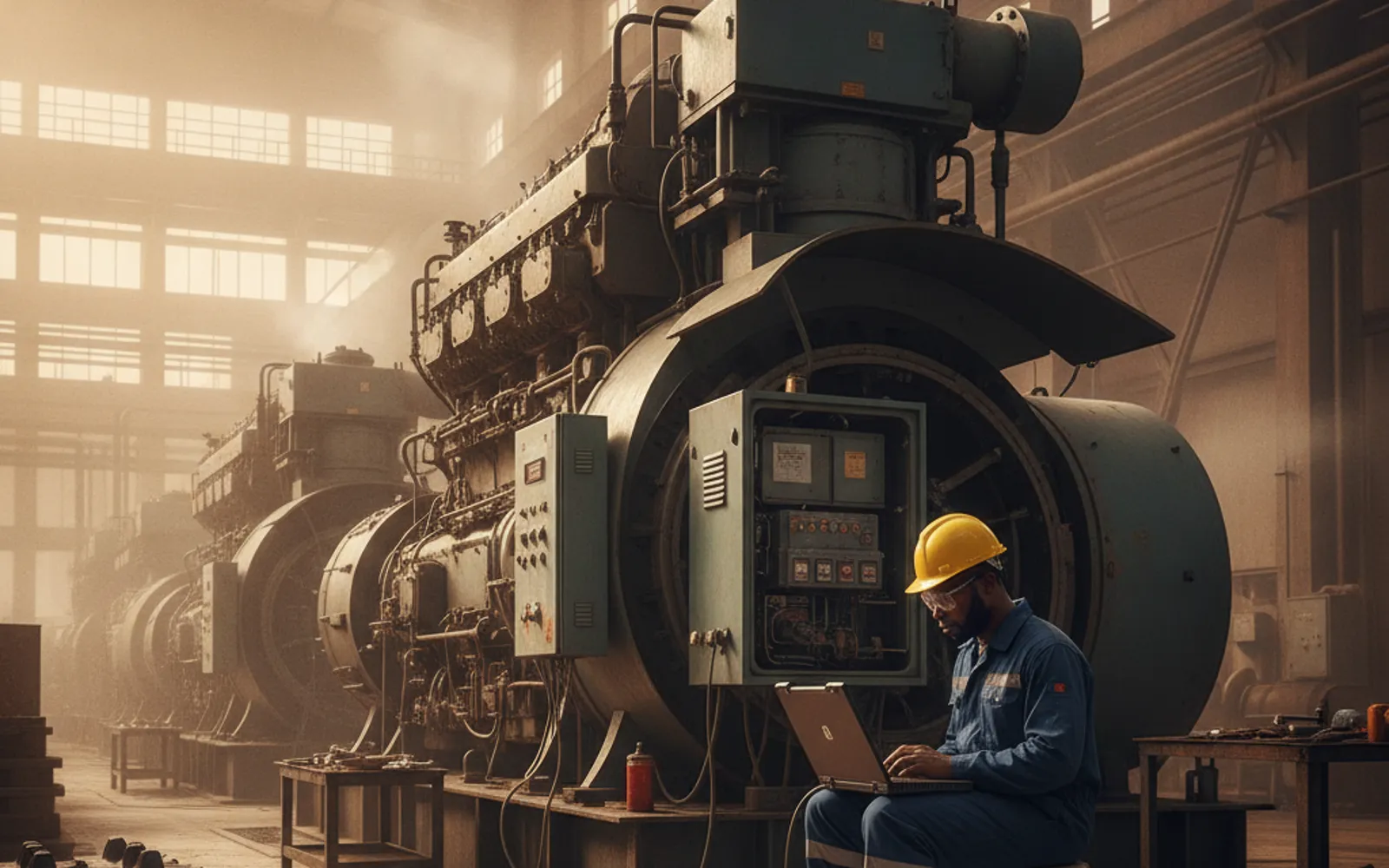
Preventive maintenance contracts, top end and major overhauls, AVR and control fault diagnosis and load bank testing for diesel and gas gensets. Based in Lagos, mobilising to Rivers, FCT, Kaduna, Delta and Kano States.
Industrial generator maintenance in Nigeria is not housekeeping, it is capacity assurance. Where grid supply is unreliable, the genset carries the plant rather than backing it up, and it runs a duty cycle the original design assumed would be occasional. We maintain diesel and gas gensets from 100 kVA to multi megawatt sets across factories, processing plants, banks, hospitals, hotels and telecom facilities, covering scheduled servicing, top end and major overhauls, AVR and control faults, load bank testing, fuel systems and cooling.
The work is driven by measured condition rather than calendar habit. Every engagement opens with running hour data, oil and coolant sample results, the site load profile and a physical inspection of engine, alternator and control panel, so the scope you approve reflects the actual state of the set. You receive a written scope, parts list, outage window and price before any spanner is lifted, and where the wider power system is in question we start with a power plant audit.
Scheduled visits tied to running hours with a calendar backstop, typically 250 and 500 hour service points and a 1,000 to 1,500 hour major inspection. Each visit closes with a signed report, oil analysis result and a list of items trending toward failure.
Cylinder head, valve train, injector and turbocharger work at top end, through to liner, piston, bearing shell and crankshaft attention at major overhaul. Scope is set by compression, blow by and oil analysis data rather than by guesswork on hours alone.
We trace voltage hunting, over voltage trips, load rejection faults and failure to build residual to the actual source, whether AVR, exciter, sensing circuit, actuator or controller. Panel wiring, ATS logic and protection settings are checked as one system.
Resistive load bank testing at 25, 50, 75 and 100 percent steps proves the set will accept its rated block load and clears the effects of prolonged light running. Voltage, frequency, exhaust temperature, coolant temperature and fuel burn are logged at every step.
Fuel quality is the largest single cause of unplanned genset failure on Nigerian sites. We handle bulk tank cleaning, water and microbial contamination, filtration and polishing, injection system service, radiator recoring, thermostats and coolant chemistry.
Where the genset carries critical load we verify start batteries and chargers, air start pressure, fuel priming, ATS transfer timing and first attempt start reliability over repeated cold starts. Findings are issued as a readiness report your operations team can work to.
A maintenance contract should state intervals, tasks, parts and response obligations in writing, not in general terms. Ours is built on running hours with a calendar backstop, because a bank branch set at 400 hours a year and a factory set at 4,000 hours a year cannot share one schedule.
Intervals vary by manufacturer and by duty. Where OEM documentation is available we follow it and state so in the contract; where a set has been rebuilt or the plate data is gone, we set intervals from condition data and revise them after two service cycles.
Most emergency call outs trace back to a small number of repeat causes. Nearly all of them are visible months in advance to anyone reading the service data, which is the argument for a contract rather than a repair budget.
We trend these through oil analysis, compression testing, thermography and load test records so the deterioration is priced into a planned outage instead of arriving as a shutdown. Where the driven plant is also in question, our rotating equipment services cover the pumps, gearboxes and compressors around the set.
Sites carrying critical load, hospitals, data rooms, bank operations centres and telecom facilities, need proof the set will accept load, not just proof it will start. A monthly no load exercise proves very little and actively damages a diesel engine over time.
A full resistive load bank test runs the set through 25, 50, 75 and 100 percent of rated output, holding at least one hour at full load, with readings logged every 15 minutes: voltage and frequency at each step, exhaust gas temperature per bank, coolant and lube oil temperature, alternator winding temperature and fuel consumption. Where transient performance matters we also test block load acceptance and voltage and frequency recovery time against the performance classes in ISO 8528-5. The output is a signed test record stating the capacity the set actually delivered, any derating found and the corrective work required.
Black start assurance goes further. For plants that must start on genset before restoring the wider system, we verify battery bank capacity under cranking load, air start pressure and receiver capacity, day tank and priming arrangements, ATS transfer time and first attempt start success over repeated cold starts. On sites where a genset backs a turbine installation, the same records feed the outage plan for steam and gas turbine overhaul.
Procurement cannot raise an order against a verbal estimate. Our proposals carry line item scope, part numbers where the OEM is known, labour hours, mobilisation, outage window and payment milestones, priced in Naira with a USD equivalent shown for comparison.
Ranges assume a rate near NGN 1,550 to the dollar and move with it. Imported OEM parts typically run 4 to 8 weeks from order to Lagos before Form M, PAAR and port clearance are counted, so we confirm the parts list from inspection first and book the outage window only when critical items are in country. A fuller breakdown sits on our generator and turbine maintenance cost page.
Mobilisation is quoted from Lagos as a separate line item, with routes and spares logistics into Lagos, Port Harcourt, Abuja, Kaduna, Warri and Kano. To begin, book a plant assessment or request a technical proposal on info@axiompowerng.com or +234 803 000 0000.
Service on running hours with a calendar backstop: a minor service at 250 hours or every 3 months, a fuller service at 500 hours, and a major inspection with oil analysis at 1,000 to 1,500 hours. A factory set running 8 hours a day reaches 250 hours in about five weeks, so the hour meter and not the calendar must drive the schedule. Dusty inland sites and coastal locations normally need air and fuel filter intervals shortened by about a third.
For a 250 to 500 kVA industrial set, expect NGN 1,800,000 to NGN 3,500,000 per unit per year (about USD 1,150 to USD 2,250) covering four scheduled visits with oil, filters and consumables. Sets above 1 MVA and multi unit sites are priced per unit against a site rate, and mobilisation outside Lagos is a separate line. We issue a fixed price contract after a plant assessment rather than a rate card, because run hours and set condition move the figure more than kVA does.
A top end overhaul on a 500 kVA class set takes 5 to 8 working days on site, and a major overhaul on a 1 MVA set takes 3 to 5 weeks. The larger variable is parts: imported OEM components typically take 4 to 8 weeks to land before clearance, so we confirm the parts list from inspection and only book the outage window when the critical items are in country. Sites with a second set or a rental bridge normally keep production running throughout.
That is wet stacking, caused by running a diesel engine below roughly 30 percent of rated load for extended periods. Unburnt fuel and soot glaze the cylinder bores and collect in the exhaust, which cuts output, fouls injectors and forces an early top end overhaul. The correction is a resistive load bank exercise at 75 to 100 percent load for at least one hour, followed by either a permanent change in load allocation or right sizing the set.
Yes. We mobilise from Lagos to Rivers, FCT, Kaduna, Delta and Kano States, covering Port Harcourt, Warri, Abuja, Kaduna and Kano. Mobilisation, travel and per diem are quoted as separate line items so procurement can see them before the order is raised. For contract sites outside Lagos we batch scheduled visits across units and hold an agreed critical spares list at site to keep response times inside the contract.
Written technical proposals. Outage support available.