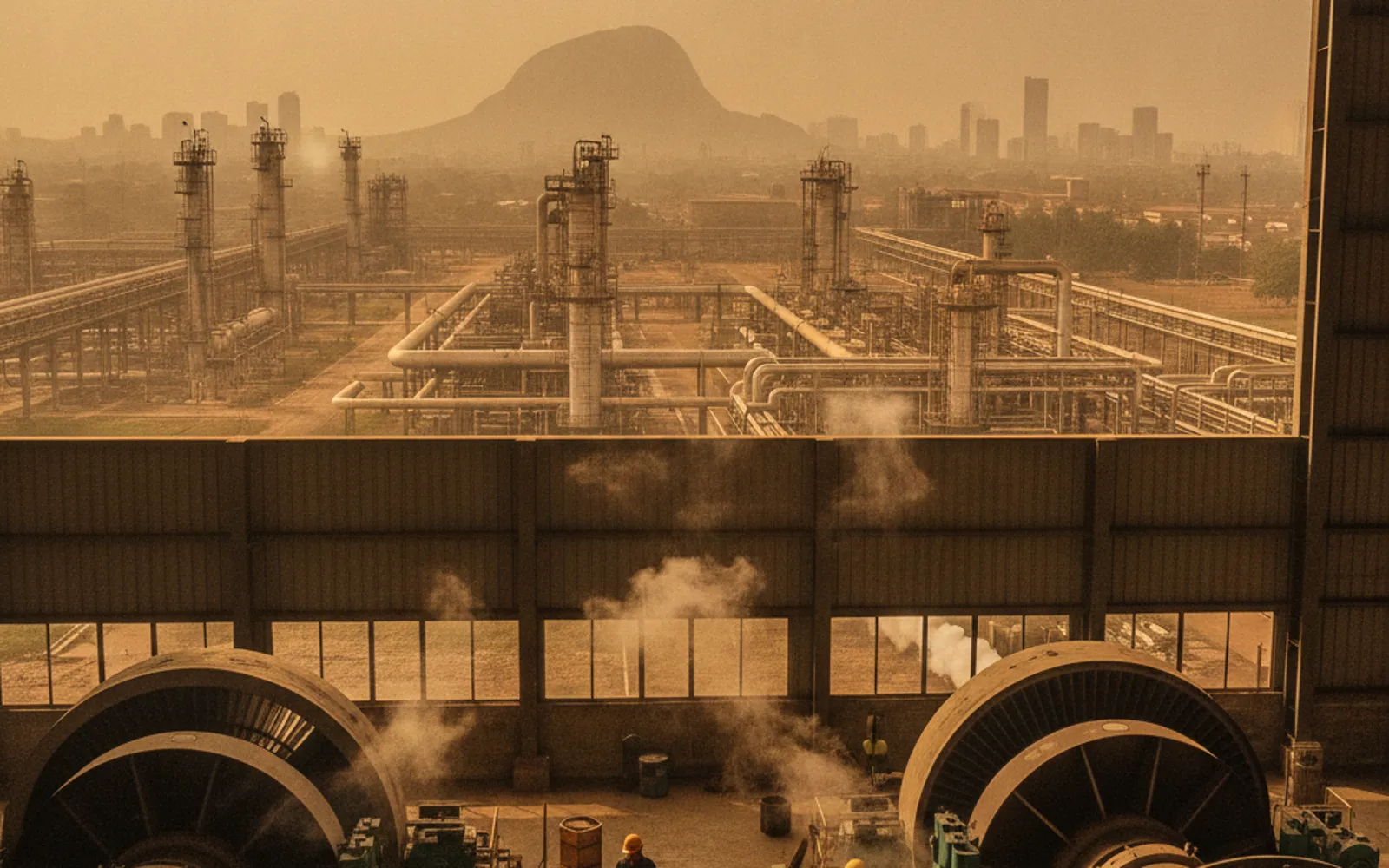
Abuja signs off on the outages that happen everywhere else, and runs one of the densest standby generation fleets in the country while it does. We support both sides: proposal grade scoping for plants in the field, and hands on service for FCT sites.
Abuja is where Nigerian power decisions are made before they are executed anywhere else. The Federal Capital Territory holds the head offices of NNPC Limited, the Federal Ministry of Power, the Nigerian Electricity Regulatory Commission, the Transmission Company of Nigeria and the Rural Electrification Agency, along with most of the independent power producers, holding companies and EPC contractors active in the market. An overhaul that will physically happen in Rivers, Delta or Kogi is still scoped, tendered and approved by people sitting in the Central Business District, and the technical proposal has to survive evaluation there before a single casing is opened.
The territory also carries a heavy standby load of its own. Federal ministries, the tertiary hospitals in AMAC and Gwagwalada, colocation data centres, bank head offices, hotels, malls, the airport and the light industry around Idu all sit behind diesel sets ranging from 100 kVA to well past 2,000 kVA, most of them idle for long stretches and then asked to pick up full building load without notice. We work both sides of that reality, combining generator maintenance and load verification for FCT sites with turbine overhaul scoping and documentation for owners whose machines sit hundreds of kilometres away.
Scheduled servicing, top overhauls and full engine rebuilds for the diesel fleets behind FCT ministries, hospitals, data centres and bank head offices. Every scope includes load bank verification, because a set that has not seen real load since the last rainy season has not been proven.
Combustion inspections, hot gas path inspections and major overhauls planned for Abuja based owners and IPPs whose units operate in the Niger Delta, the North West or along the Kogi corridor. Borescope findings, clearance records and parts lead times are written up in a form your evaluation committee can score line by line.
Independent condition, heat rate and specific fuel consumption audits built for budget defence, tender preparation and capital planning cycles that run on the federal calendar. You receive a ranked intervention list with Naira costs and the technical basis for each figure.
Laser shaft alignment, in situ field balancing, vibration analysis and bearing renewal on pumps, fans, blowers and air compressors across FCT water treatment, hospital plant rooms, hotels and process facilities. Baselines are recorded so the next reading means something.
The commercial centre of gravity for Nigerian power sits in the FCT while the iron sits elsewhere. Federal agencies and most IPPs split technical and commercial evaluation, which means a bid can be technically disqualified weeks before anyone looks at your price. Plant managers in Port Harcourt know what the machine needs; the challenge is getting that need through an Abuja evaluation process without it being cut, deferred or awarded to whoever wrote the tidier submission.
Our documentation is built for that room. A proposal covers the scope of work broken down by component, the inspection methodology, the tooling and lifting equipment to be mobilised, a spares list with OEM and qualified alternate part numbers, realistic lead times against current import timelines, an HSE plan and an outage schedule you can hold a contractor to. Prices are stated in Naira with the USD equivalent shown for imported components, so your finance team can see exactly where the exchange rate exposure sits.
Execution then happens where your plant is. Our field teams work out of Lagos and mobilise to Port Harcourt, Warri, Kaduna and Kano, with the technical and commercial interface kept in Abuja where your procurement and engineering leads actually sit.
From December to February the harmattan pushes fine Sahelian dust across the territory, and it finds every machine. Air filter restriction climbs far faster than the service manual assumes, radiator and charge air cooler fins blind over, and alternator windings and switchgear pick up a conductive film that shows up first as falling insulation resistance and later as a flashover. On FCT sites we shorten filter and cooling pack intervals through those months and take insulation resistance and polarisation index readings rather than waiting for a failure to report the condition.
Altitude and ambient temperature then take a bite out of nameplate output. Abuja sits several hundred metres above sea level, and by March and April afternoon ambients climb close to 40 degrees Celsius. Machines rated at ISO conditions will not make catalogue output in that air, and the gap matters most in basement and enclosed genset rooms where recirculation pushes intake air well above the outside temperature. We measure actual intake and discharge conditions during the survey instead of assuming the room is as designed.
Standby duty creates its own failure modes. Sets that run lightly loaded for short weekly exercises glaze their bores and wet stack, fuel that sits for six months or more in a day tank grows water and microbial contamination, coolant loses inhibitor strength, and flat or sulphated batteries remain the single most common cause of a no start when the grid finally drops. The counter is calendar based servicing, fuel sampling and polishing, and an annual load bank test at 80 to 100 per cent for two to four hours, documented.
Work starts with a plant assessment rather than a quotation. We capture nameplate and run hour data, pull oil samples for wear metal and viscosity analysis, take vibration baselines on rotating plant, run thermography across switchgear and connections, borescope where the machine allows it, and read the real load profile from DisCo bills and genset hour meters. That gives a defensible picture of what has actually worn rather than what the interval table says should have.
Pricing follows from that picture. Naira figures are broken out by labour, consumables, imported parts and mobilisation, with USD equivalents shown for anything sourced abroad and lead time risk stated openly rather than buried. The scale is easy to underestimate: a 1,000 kVA set held at 75 per cent load burns in the region of 160 litres of diesel an hour, so a week of continuous outage cover in the FCT runs into tens of millions of Naira in fuel alone before a spanner is lifted. Indicative ranges are set out on our maintenance cost page.
Control during the outage is what protects the schedule. Parts are confirmed on site before the machine is opened, as found and as left clearances are recorded, torque values and alignment readings are logged, and the handover file goes to your engineering team with the evidence attached. Where the objective is a capital case rather than a repair, a plant audit or a rotating equipment survey is usually the cheaper first step.
Yes, and it is the most common arrangement we work in. Technical and commercial engagement stays with your team in the FCT, including proposal reviews, clarification rounds and progress reporting, while execution runs at site. Field mobilisation covers Port Harcourt, Warri, Lagos, Kaduna and Kano.
For a plant assessment or survey within Abuja and the surrounding area councils we normally schedule inside the working week, and travel is rarely the constraint. What actually determines your restoration date is parts availability and import lead time, particularly for turbine hot section components and large engine assemblies. We state those lead times in the proposal rather than after award.
Yes. Submissions are written against the evaluation criteria in your invitation to tender and include a component level scope of work, inspection methodology, tooling and manpower schedule, spares list with part numbers and lead times, HSE plan and an outage bar chart. Where a clarification round follows, we respond in writing with the technical basis stated so your committee has something to score.
Standby sets fail from sitting, not from running, so hours based intervals will mislead you. Fuel degrades and picks up water and microbial growth, batteries sulphate, coolant inhibitors deplete, and lightly loaded exercise runs glaze the bores and leave unburnt fuel in the exhaust. A calendar based schedule with fuel testing, battery load testing and an annual load bank run is the difference between a set that starts and a set that merely turns over.
Written technical proposals. Outage support available.