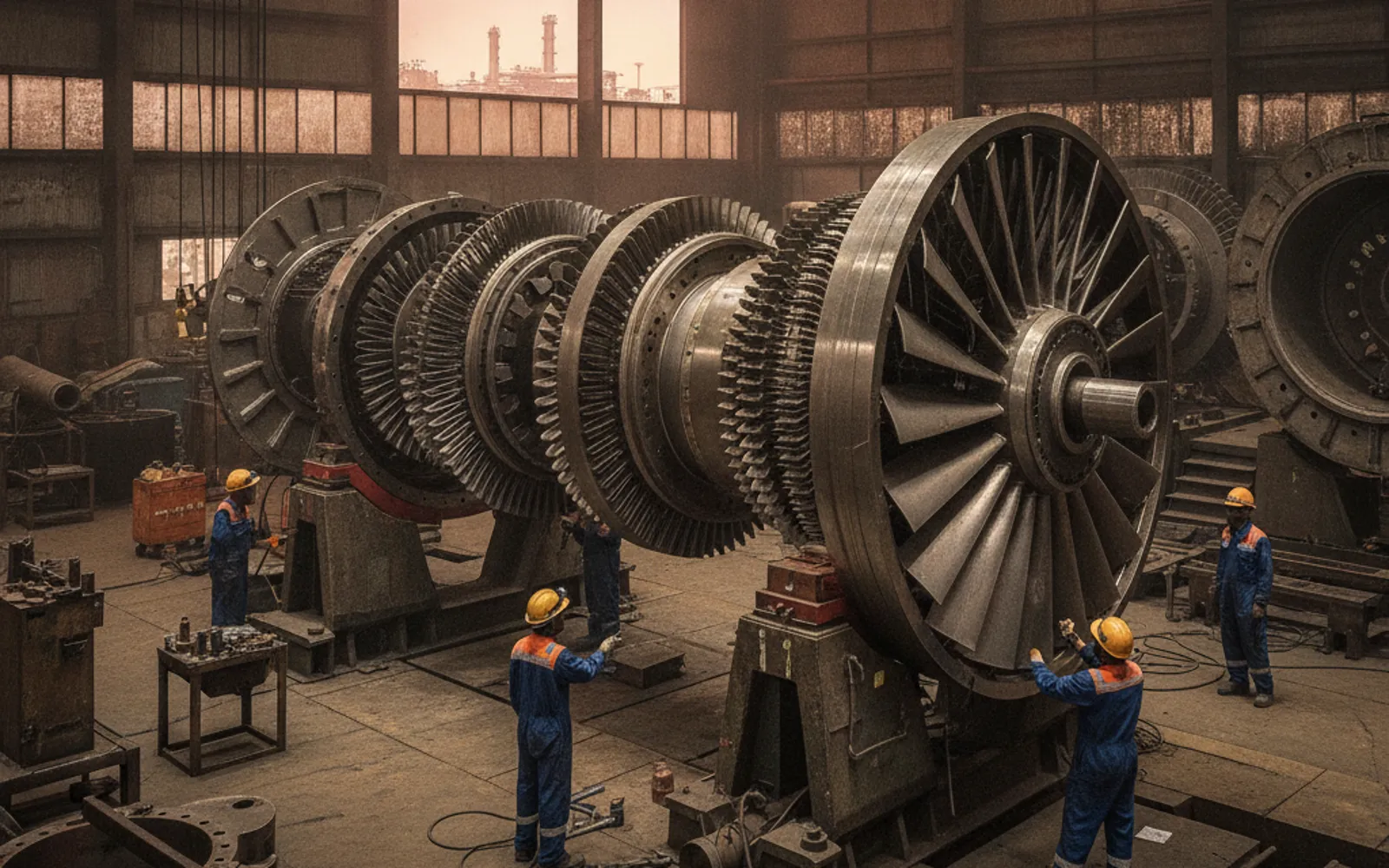
Major and minor outage execution for steam and gas turbines, from scope development and steam path inspection through to balancing and recommissioning. Based in Lagos, mobilising to plants in Rivers, Delta, FCT, Kaduna and Kano States.
A steam turbine overhaul in Nigeria is seldom a clean textbook job. Much of the thermal fleet in country has run well past its inspection window, and units arrive at outage with incomplete history files, missing clearance records and spares that were never ordered. We execute major and minor outages on steam and gas turbines, covering scope development, steam path inspection, rotor and blade assessment, bearing and seal replacement, alignment, balancing and recommissioning.
Our engineers work to a written scope agreed before mobilisation, with a separate pre-priced allowance for findings, so that a discovered rim crack or a wiped thrust pad does not stall the outage while commercial terms are renegotiated. Every unit is handed back with clearance sheets, alignment records, NDT reports, balance data and a baseline vibration signature. If the condition of the plant has to be established before you commit to a scope, start with a power plant audit.
We build the scope from operating hours, trip and start history, vibration trends, heat rate drift and the last inspection records. The result is a scope of work a procurement officer can price line by line rather than a lump sum with open ends.
Casing lift and full steam path inspection covering nozzle blocks, diaphragms, moving and stationary blading, shrouds, tenons and lacing wires. Deposits, erosion, rubs and mechanical damage are mapped, photographed and recorded stage by stage.
Magnetic particle and dye penetrant inspection of the rotor body, discs, keyways and blade roots, with ultrasonic testing and bore inspection where the design allows. Findings are reported against repair, run and replace options with the cost and lead time of each.
Journal and thrust bearing inspection, babbitt condition assessment, rebabbitting or renewal, and restoration of labyrinth, gland and interstage seal clearances. All as found and as left clearances are recorded on signed sheets.
Cold and hot alignment of the turbine, gearbox and driven machine, plus soleplate, chock and catenary checks where the train demands it. Low speed shop balancing and field trim balancing bring the rotor within accepted vibration limits at operating speed.
Protective device and overspeed trip testing, controlled run up, load steps, and capture of a fresh vibration and performance baseline. You receive a close out dossier that supports the next outage rather than a verbal sign off.
A minor outage opens the machine far enough to confirm condition without full disassembly of the rotor, and typically runs 10 to 14 days on a single casing industrial unit. A major outage lifts the rotor out, restores clearances and returns the machine to a known datum, and typically runs 4 to 8 weeks depending on findings and on spares already held. The difference in downtime cost is usually larger than the difference in overhaul cost, which is why the interval decision belongs to a planning meeting and not to a breakdown.
For steam turbines we plan minor inspections at roughly 25,000 to 30,000 operating hours and majors at 50,000 to 60,000 hours or 6 to 8 years, whichever falls first. For gas turbines the counter is equivalent operating hours: combustion inspection near 8,000 EOH, hot gas path inspection near 24,000 EOH and a major inspection near 48,000 EOH, factored for fuel quality, trips and start frequency.
Most of what shortens turbine life in Nigeria is visible in the steam path once the casing is off. Solid particle erosion from oxide exfoliation off superheater and reheater tubing cuts the leading edges of HP first stage nozzles and blading, opening throat areas and pushing stage pressures out of design. At the other end, moisture erosion attacks the last LP stages where wetness fraction is high and stellite shielding has worn or was never fitted.
Water chemistry is the second recurring cause. Silica and sodium carryover from poorly controlled drum chemistry deposits on blading, raises first stage pressure, loads the thrust bearing and drops output before anyone associates the loss with the turbine. Deposit sampling, thickness mapping and stage pressure comparison against design tell you whether the unit needs a chemical clean, a blast clean or blade replacement.
On the rotor itself we look for stress corrosion cracking at disc rims, keyways and blade attachment grooves, fretting at blade roots and dovetails, cracked shroud tenons and broken lacing wires, plus rub marks that show where differential expansion or a bowed rotor made contact. Each finding is written up with its inspection method, extent and the engineering options available, so the decision to repair, run to the next outage or replace is a documented one. Where the driven end is the issue rather than the turbine, our rotating equipment services cover the pumps, gearboxes and compressors in the same train.
Bearings tell the truth about how a machine has been run. We assess babbitt condition, wiping, fatigue cracking and electrical pitting, then set journal clearance to design, generally in the region of 0.0015 to 0.002 times shaft diameter, and reset thrust float and axial position. Oil condition, filtration, cooler duty and lube oil temperature are checked at the same time, because most repeat bearing failures are lubrication failures wearing a bearing badge.
Seal and clearance restoration is where much of the recovered efficiency sits. Rubbed labyrinth and gland seal strips are replaced and set to drawing, interstage clearances are restored, and gland steam and vacuum conditions are corrected so the unit is not pulling air into the condenser after the outage. On reassembly the train is aligned cold and confirmed hot, typically holding the coupling within 0.05 mm on the final set, with thermal growth allowances applied for the specific casing and support arrangement.
Rotors are low speed balanced after any blade work, then trim balanced in the field at operating speed where residual unbalance calls for it. Acceptance is judged against ISO 20816 vibration limits and the OEM or API criteria applicable to the machine, not against a subjective feel of the bearing housing. Recommissioning then covers protection and interlock proving, overspeed trip testing, controlled run up, load steps and capture of the new baseline that will be used to schedule the next inspection.
The single biggest reason Nigerian turbine outages overrun is spares. A rotor that goes for repair, a set of replacement blading or a new diaphragm set is a manufactured item with a queue in front of it, and import clearance sits on top of that. Plan on 12 to 26 weeks for blading, diaphragms and bearing sets, and 30 to 52 weeks for a rotor forging or a full reblade, before Form M, PAAR and clearance at Apapa, Tin Can or Onne are counted.
That arithmetic means scope development has to start 6 to 9 months before the outage window, not 6 weeks. We use the pre outage borescope survey, vibration and performance data and the last inspection dossier to split the work into confirmed scope, probable scope and contingency, then place long lead items against the confirmed and probable portions early. Consumables, gaskets, fasteners, seal strips and bearing spares are held at site before mobilisation so no crew stands idle waiting on a courier.
The same discipline applies to the commercial side. You get a scope of work, a bill of quantities, a bar chart with float shown, a manpower schedule and a rate for extra work found during disassembly, which is what a purchase order actually needs. Indicative budgets are set out on our turbine and generator maintenance cost page, and standby power in the same plant is covered under generator maintenance.
We mobilise from Lagos to plants across the country, with crews regularly working Lagos, Port Harcourt, Warri, Abuja, Kaduna and Kano. To start, book a plant assessment or request a technical proposal on info@axiompowerng.com or +234 803 000 0000.
As a planning rule, a minor or inspection outage falls at about 25,000 to 30,000 operating hours and a major overhaul at 50,000 to 60,000 hours, or 6 to 8 years, whichever comes first. Trip count, start frequency, steam chemistry and load profile move those numbers, so the interval is confirmed against the actual running history rather than assumed. Units that have run through deferred outages are assessed on condition first, using borescope survey, vibration data and stage pressure comparison.
A minor outage on a single casing industrial steam turbine normally takes 10 to 14 days on site. A major overhaul with rotor removal, full NDT and clearance restoration runs 4 to 8 weeks, and longer if blading or a diaphragm set has to be manufactured. The dates hold when long lead spares were ordered ahead of the window, which is why we build the outage bar chart around spares delivery and not around crew availability.
For an industrial steam turbine in the 5 to 15 MW class, a minor inspection outage typically falls between NGN 35,000,000 and NGN 90,000,000 (about USD 23,000 to USD 60,000). A major overhaul with rotor removal, NDT, bearing renewal and clearance restoration typically falls between NGN 250,000,000 and NGN 900,000,000 (about USD 165,000 to USD 600,000), excluding long lead spares such as blading, diaphragms or a rotor repair. Final figures come from the scope of work and bill of quantities issued after the plant assessment.
Yes. Gas turbine work is counted in equivalent operating hours: combustion inspection near 8,000 EOH, hot gas path inspection near 24,000 EOH and major inspection near 48,000 EOH. Those counters are adjusted for fuel type, trip history and start frequency, since a peaking unit on frequent starts consumes hot section life far faster than a base loaded machine. Borescope surveys between outages let you confirm liner, transition piece and blade condition without opening the machine.
Machine nameplate data, the OEM manual or general arrangement drawing if held, operating hours since the last inspection, trip and start counts, recent vibration and performance data, and the last inspection or clearance records. Where those records are missing, which is common, we run a plant assessment and borescope survey first and build the scope from what the machine shows. From there you receive a scope of work, bill of quantities, outage bar chart, manpower schedule and a rate for work found during disassembly.
Written technical proposals. Outage support available.