
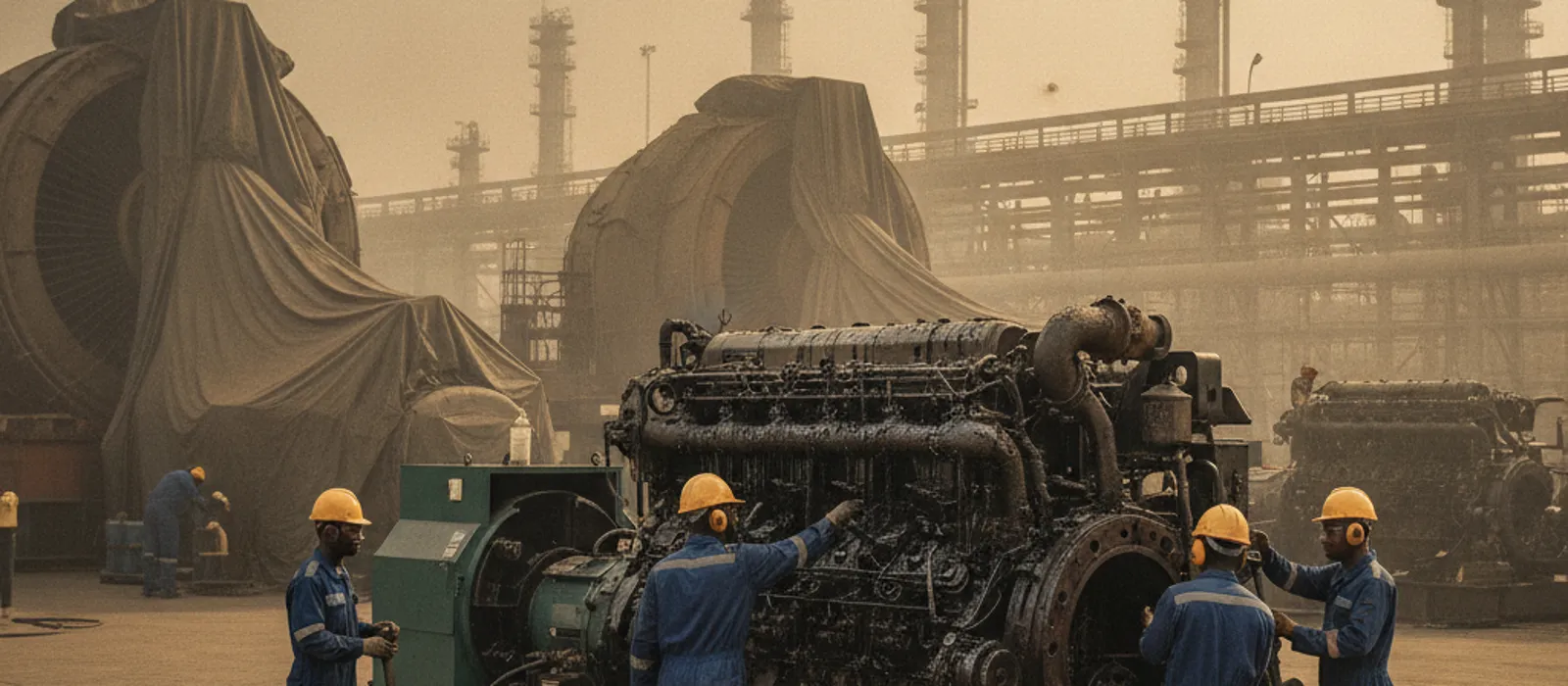
Take a 500 kVA standby set that runs 2,900 hours over two years at an average load of 61 kW, about 15 percent of its rated output. When the load finally calls for all of it during a long outage, it smokes heavily, refuses the last load step, and part of the load has to be shed. The recovery that follows is a top end repair, priced on scope and parts condition rather than a fixed figure, and none of it was caused by hard work.
That is wet stacking in diesel generators, and it is one of the few failure mechanisms in rotating plant caused entirely by underuse. The set was not abused. It was oversized at specification stage, then run for years at a load its combustion process could not sustain cleanly.
Why wet stacking in diesel generators starts with combustion temperature
A diesel engine ignites by compression, which depends on getting the charge air hot enough at top dead centre. At high load the cylinder runs hot and the fuel burns close to completely. At 15 or 20 percent load the injected quantity is small, liner and head temperatures fall well below design, and a measurable fraction of the fuel never burns.
Three things follow from that, and they compound. Unburned diesel washes the oil film off the cylinder wall and drains past the rings into the sump, and that fuel dilution drops lube oil viscosity and flash point, which is a bearing risk long before it is a power complaint.
Combustion pressure is also what forces the piston rings outward against the liner. At light load that pressure is low, ring sealing is poor, and blow-by carries fuel and oil mist into the crankcase while oil passes upward into the exhaust.
On turbocharged sets, low exhaust energy means low pressure in the turbine housing, so lube oil migrates past the turbo shaft seals into the exhaust stream. That is why the deposit at the flange joints is oily rather than dry soot.
The residue is unburned fuel, lube oil and soot condensate collecting in the manifold, turbine housing, silencer and stack. The stack literally runs wet, which is where the name comes from. Carbon also builds on injector tips, valve seats and the turbocharger nozzle ring, so spray pattern and gas path efficiency both degrade.
The expensive endpoint is bore glazing. The honing crosshatch in the liner, which is what holds the oil film, polishes over with low temperature deposits under low ring pressure. Oil consumption then rises permanently and compression falls, and no amount of running the set hard will reverse it.
If your sets run below a third of their rating most of the time, book a plant assessment and get the load profile measured before the fouling reaches the liners.
The load thresholds that decide whether a lightly loaded diesel generator fouls
Start with what the set was sold as. ISO 8528 rating classes are not interchangeable, and prime power ratings assume an average load factor over 24 hours that is commonly around 70 percent. Standby ratings assume limited annual hours. Neither class was designed around a set idling at 12 percent for years. The standards catalogue is published by ISO, and ISO 8528-1 is the reference worth keeping on file.
Most engine manufacturers set a minimum continuous load between 30 and 40 percent of set rating for extended running, and below that they specify periodic loading to full output to clear deposits. The exact figure varies by engine family and aspiration arrangement, so read the OEM manual for your model rather than applying one rule across a mixed fleet.
The practical thresholds in Nigerian service look like this. Above roughly 60 percent average load, fouling is not a live concern and your problems will be fuel quality, air restriction and cooling instead. Between 30 and 60 percent, the set stays acceptably clean provided it sees full load periodically. Below 30 percent sustained, expect fouling within a few thousand hours, and below 15 percent expect it within one service interval.
The causes of chronic light loading are nearly always decisions made before the set arrived. Sizing off the sum of nameplate ratings rather than measured demand. Adding a safety margin on top of a figure that already contained one. Specifying for a phase two expansion that never happened. Our generator sizing guide covers setting that baseline properly at specification stage.
One newer cause deserves care. Adding solar and battery storage genuinely reduces fuel burn, but it also strips the daytime base load off the generator and can push a healthy set below its minimum load. Solar does not remove the need for the engine to run loaded when it runs. A hybrid design without a generator control strategy, whether that is load blocking, a smaller lead set or a dump load, converts a fuel saving into an overhaul bill.
Symptoms: confirming wet stacking before it costs you a top end
The diagnosis is not difficult, but it does need instruments rather than opinions. Work through this list before authorising any work.
- Wet, black, oily deposit at exhaust flanges, the silencer drain and the stack base. Dry sooty deposit points elsewhere.
- Continuous dark exhaust that does not clear when load is applied, as distinct from a brief puff on load acceptance.
- Exhaust gas temperatures below the OEM figure at the given load, measured per cylinder where the instrumentation allows. A wide spread between cylinders points at injectors rather than load factor alone.
- Lube oil level rising between top-ups. Fuel dilution adds volume, and a rising level with falling viscosity is close to diagnostic.
- Oil analysis showing fuel dilution above about 2 to 4 percent with flash point depressed. Quarterly sampling is the cheapest instrument on the site.
- Elevated crankcase pressure and visible blow-by at the breather.
- The set will not take its last load step, or hunts when it does.
Separate this from the two conditions that mimic it. Contaminated or adulterated fuel produces smoke, injector coking and power loss without the oily wet residue, and that damage pattern is covered in contaminated diesel generator damage. Air side restriction, a blinded filter or a failed charge air cooler produces black smoke and low power with normal or high exhaust temperatures. A burn-off on a set that is actually starved of air achieves nothing except heat.
What chronic light loading actually costs
Hypothetical example: a 500 kVA prime set as the main supply, average draw 68 kW, with short peaks to 210 kW when two loads overlap. That is 17 percent average load. Specific fuel consumption sat near 0.41 litres per kWh against roughly 0.27 at healthy loading, which on 5,800 running hours a year works out to about 91,000 litres of avoidable AGO. Injectors and the turbocharger also needed attention at 4,100 hours instead of the expected interval. Reconfiguring to a 200 kVA lead set with the 500 kVA held for peak and standby fixed both problems inside a year.
Hypothetical example: two 250 kVA sets on an alternating weekly changeover, neither ever carrying more than 44 kW. The monthly exercise consisted of 20 minutes off load, which added carbon rather than removing it. Both sets were wet stacked at the first annual inspection. Recovery was a burn-off on each machine plus injector service, and the fix that mattered was cheap: block one set out of service, run the other as lead at 35 percent, rotate quarterly.
Recovery interventions for a 500 kVA class set typically look like this. Cost is driven by engine family, spares lead time, condition at strip and FX exposure, so scope should be quoted against your set rather than a rate card.
| Intervention | What it addresses | Outage window |
|---|---|---|
| Resistive load bank burn-off, staged to 100 percent | Light fouling in manifold, turbine housing and stack | Half a day |
| Injector service or replacement set | Coked tips, poor spray pattern, cylinder imbalance | 1 to 2 days |
| Turbocharger overhaul or cartridge exchange | Carbon on nozzle ring, shaft seal oil migration | 2 to 4 days plus parts lead time |
| Manifold, silencer and stack decarbonising | Accumulated wet carbon and back pressure rise | 1 to 2 days |
| Top end overhaul, heads, valves, injectors, liner inspection | Valve seat carbon, compression loss, confirmed glazing | 4 to 8 days |
| Major overhaul with liner and ring replacement | Bore glazing, high oil consumption, low compression | 2 to 4 weeks |
| Automatic load bank, 200 kW, permanently installed | Standby sets that will never see real load | Installation only |
Cost moves with engine family, spares lead time and condition at strip, so treat the table as a scoping guide rather than a quotation. To scope which of those lines your fleet actually needs, request a technical proposal and an engineer will review the load profile before anything is quoted.
Recovering a wet stacked set, in the order the work should be done
Do not start with the load bank. Running a fuel diluted sump hard is how a fouling problem becomes a bearing failure.
Take an oil sample and read the result first, and if dilution is significant change oil and filters before applying any load. Drain accumulated liquid from the exhaust system, because heating a manifold full of unburned fuel is a fire risk that has caught out more than one site.
Then apply load progressively with a resistive load bank rather than by dumping the building onto the set. A typical sequence is 30 percent for 30 minutes, 50 percent for 30 minutes, 75 percent for an hour, then 100 percent held for one to two hours while an engineer watches exhaust temperature, coolant temperature and crankcase pressure. Light fouling clears in that window. The procedure and what a proper report should contain are covered in generator load bank testing.
Stop the burn-off if the temperature spread across cylinders stays wide, if the set will not hold 100 percent, or if smoke does not clear by the end of the hold. Those are mechanical findings, and continuing simply bakes the deposits harder. What follows is injector bench testing, turbocharger inspection, compression checks and exhaust decarbonising, which is workshop and outage work needing proper equipment and a qualified engineer on site.
Bore glazing cannot be burned off. If oil consumption and compression point that way, the honest answer is heads off, liners inspected, and a decision between deglazing and replacement.
Be equally honest about the limit of the exercise. A burn-off treats the deposit, not the cause. If the load profile does not change, the set fouls again on the same timetable, which is why recovery and load reconfiguration belong in the same generator maintenance plan.
Preventing it: sizing, load strategy and a real exercise regime
Size against a measured load profile, ideally a week of logged data covering peak shift and weekend conditions, not the sum of nameplate ratings. A power plant audit that produces a half-hourly load curve is the input that makes every later decision cheaper.
Prefer two or three smaller sets in parallel over one large machine wherever load varies widely. Parallel sets let you run one machine at 70 percent instead of one at 20 percent, and they give you redundancy a single set never provides.
For standby sets on critical loads, a monthly exercise at 30 percent or more of nameplate for at least 30 minutes, plus an annual load bank test at full rating, is the widely used reference regime and is close to what NFPA 110 requires of emergency power systems in healthcare. It is not Nigerian law, but it is a defensible internal standard, and the codes are catalogued by the NFPA. A 20 minute off load run proves the starter battery and nothing else.
Where a set will never see real load, price a permanent automatic load bank against the overhaul it prevents. Finally, put fuel dilution on the quarterly oil analysis report as a flagged parameter with a threshold and a named owner. It is the earliest cheap warning you will get.
Frequently Asked Questions
Can wet stacking damage a diesel generator permanently?
Yes, if it runs long enough. Deposits in the exhaust, on injectors and in the turbocharger are recoverable with a burn-off and mechanical service. Bore glazing and the compression loss that follows are not, and that stage requires heads off with liner deglazing or replacement. The point of catching it early is that the difference between the two outcomes is roughly a factor of three in cost.
What is the minimum load a diesel generator should carry?
Most manufacturers specify 30 to 40 percent of set rating for extended continuous running, with periodic operation at full load to clear deposits. The precise figure depends on the engine family, the aspiration arrangement and the site ambient, so use the OEM manual for your model rather than a general rule. Below 30 percent sustained, plan a loading regime deliberately rather than hoping.
Will a monthly no-load test run prevent wet stacking?
No, and it makes matters slightly worse. An off load or lightly loaded exercise run raises the very conditions that cause fouling, so it deposits carbon rather than removing it. An exercise regime only helps when the set carries meaningful load, which means at least 30 percent of nameplate for a sustained period, or a load bank where the site load cannot supply that.
How long does a load bank burn-off take and will it fix the problem?
Plan a half day per set, including staged loading and a one to two hour hold at full rating. That clears light and moderate fouling in the gas path and exhaust. It will not fix coked injectors, a carboned turbocharger or a glazed bore, and it will not stop the fouling returning if the underlying load profile stays the same. Treat it as a diagnostic and a cleaning step, not a cure.