
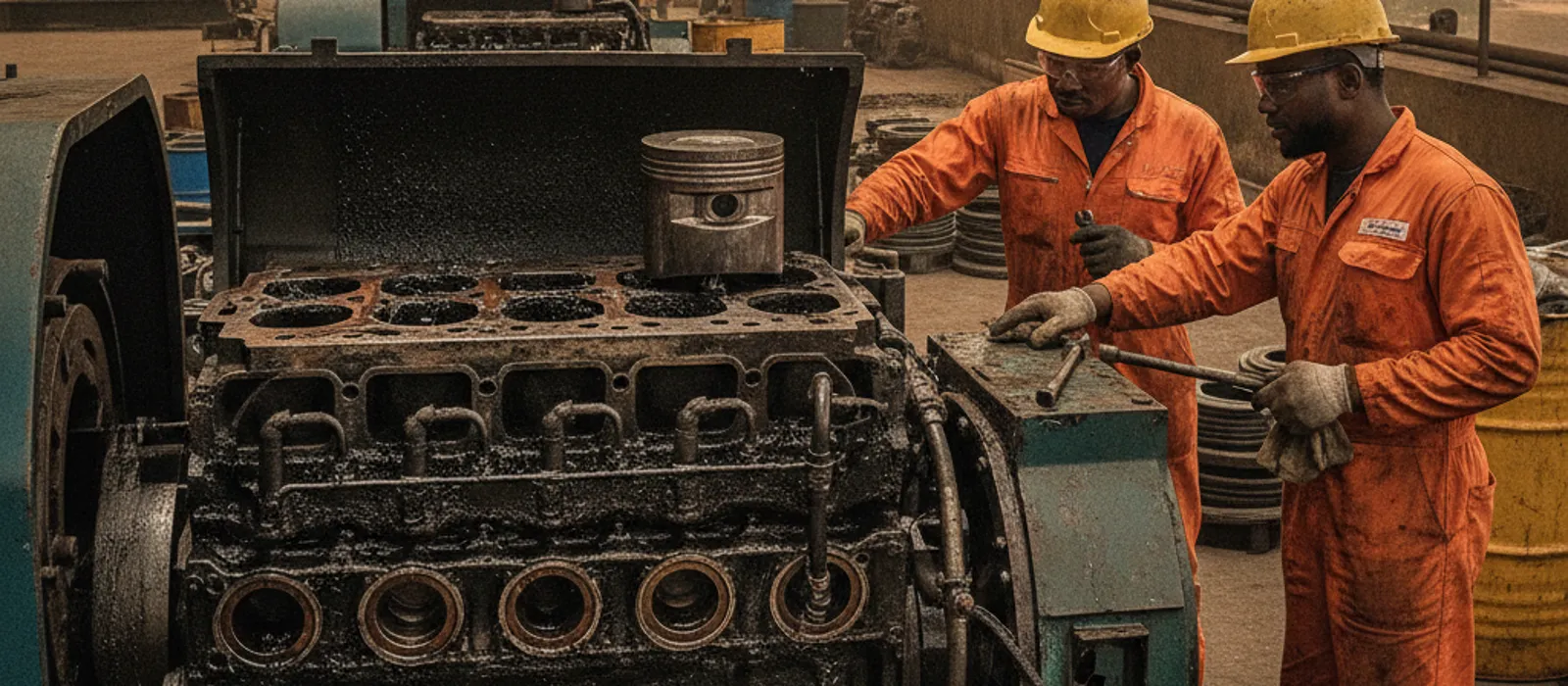
A 200 kVA standby set can run eleven months without a single fault code, then lose three injectors and a high pressure fuel pump inside the same fortnight. The repair for that kind of failure runs into several times the cost of the prevention that would have stopped it, plus days lost to hired plant while the set is down. The contaminated delivery that caused it can sit in the tank for weeks or months before the damage shows.
Contaminated diesel generator damage almost never announces itself on the day the bad fuel arrives. It accumulates in the bottom of a tank, migrates through a filter that nobody is monitoring, and presents months later as an expensive mechanical failure that gets written up as bad luck or a bad batch of parts. By then the evidence has been burnt.
This article sets out where the contamination comes from, what it does inside the injection system, the checks you can run without a laboratory, and what the failures typically cost against the price of prevention.
How Diesel Gets Contaminated Between the Depot and Your Day Tank
Fuel that leaves a licensed depot on specification can still reach your injectors out of specification. There are four routes, and most sites are exposed to at least three.
Water is the first and the most common. It arrives dissolved in the fuel, condenses inside a half empty tank as temperature swings between day and night, and enters through loose fill caps, failed gauges and rainwater on a poorly graded tank pad. In the humid coastal air of Lagos, Port Harcourt and Warri, a half full tank makes its own water without help from a supplier.
Particulate is the second. Rust and scale from the inside of an ageing steel tank, sand and harmattan dust drawn in through an unfiltered tank vent, and welding slag or grit left behind at installation all end up in suspension. Fine particulate is the material that scores pump elements and cuts injector seats.
Microbial growth is the third, and it is misunderstood. What operators call diesel bug lives at the interface between water and fuel, not in the fuel itself, so removing the free water removes the habitat. Leave 30 mm of water in a warm tank for three months and it will produce a dark slime that blinds filters and releases biomass in slugs whenever the tank is disturbed.
Adulteration and degradation make up the fourth. Product blended down the supply chain, and simple oxidation of fuel held too long, both change how the fuel burns and where it deposits. Diesel held beyond six to twelve months without a stabiliser forms gums that lacquer injector needles.
If you are not certain which of these applies to your site, book a plant assessment and we will sample the tank bottom, the day tank and the delivery point before anyone recommends a spend.
What Contaminated Diesel Generator Damage Looks Like Inside the Engine
The injection system is the part that pays. Diesel is not just the fuel in a modern engine, it is also the lubricant and coolant for the high pressure pump and the injector internals, and it is metered through clearances measured in single microns.
Water destroys that in three separate ways. It displaces the fuel film in the pump and allows metal to metal contact, it flashes to steam at the injector tip and erodes the nozzle by cavitation, and it corrodes the ground surfaces of plungers and needles into a pitted finish that no longer seals. A common rail system operating at 1,600 to 2,500 bar has no tolerance for any of that.
Particulate works faster and more visibly. Abrasive wear opens the clearance between plunger and barrel, delivery pressure falls, the injector begins to dribble instead of atomising, and combustion goes ragged. The visible symptoms are black smoke, hard starting, hunting under load and a drop in available output, and the wider diagnostic path is covered in our note on generator low output causes.
Microbial contamination attacks differently. Biomass blinds filters and starves the engine, which shows up as a set that runs cleanly at light load and shuts down on low fuel pressure the moment it is asked for full output. The organisms also produce organic acids that pit the tank floor and the fuel gallery.
There is a secondary chain of damage that costs more than the injectors. Poor atomisation means incomplete combustion, which on a lightly loaded set accelerates wet stacking, bore glazing and turbocharger fouling, a mechanism set out in our article on diesel generator wet stacking. Unburnt fuel also dilutes the lube oil, which is why fuel contamination often shows in an oil sample first.
By the time the engine misbehaves you are already paying for parts. The window in which the problem was cheap closed months earlier, at the filter and the dip stick.
The Fuel Quality Checks Every Plant Should Run
Most of what matters can be established on site by a competent technician with simple equipment. Laboratory work is for confirming a suspicion and for holding a supplier to account, not for routine surveillance.
The single most useful indicator costs nothing. Track filter life in running hours and write it down. A primary filter that used to last 500 hours and now lasts 120 is telling you the tank is dirty, and it is telling you long before the engine does.
| Check | What it detects | Frequency | Act when |
|---|---|---|---|
| Tank dip with water finding paste, then drain the sump | Free water and settled sludge | Weekly | Any colour change, or cloudy dark drawings |
| Filter differential pressure and element life log | Particulate and biomass loading | Every service | Element life falls by a third or more |
| Clear jar sample from tank bottom and day tank | Water haze, sediment, dark slime | Monthly | Sample is not bright and clear |
| Microbial dip slide or ATP test | Bacteria and fungi at the water interface | Quarterly | Any moderate or heavy growth reading |
| Sealed sample retained from each tanker | Supplier accountability, adulteration | Every delivery | Density, colour or smell varies from the norm |
| Full laboratory fuel analysis | Water and sediment, density, flash point, cleanliness code | Annually, or in dispute | Any result outside the fuel specification |
The clear jar test is the most underrated tool on a Nigerian plant. Draw a sample from the lowest point of the tank into a clean glass jar, stand it for fifteen minutes and hold it against a white background. Clean diesel is bright and clear. Haze means suspended water, a layer at the bottom means free water, and dark stringy material at the interface means a biological problem rather than a housekeeping one.
The retained delivery sample changes commercial behaviour. When a haulier knows a sealed and labelled sample is taken from every load and kept for ninety days, the quality of what arrives improves. Downstream petroleum product supply is regulated by the Nigerian Midstream and Downstream Petroleum Regulatory Authority at nmdpra.gov.ng. Cleanliness is expressed under the ISO 4406 coding system, published by iso.org, and many common rail engine makers specify a code in the region of 18/16/13 or cleaner at the injector. Bulk fuel reaching a typical Nigerian industrial tank is routinely several codes dirtier, which is why filtration matters more here than the engine manual assumes.
To have a sampling and testing regime written for your site and your set, request a technical proposal.
What Diesel Contamination Damage Costs: Two Worked Examples
The pattern is easier to see worked through than described in the abstract, so here are two.
Hypothetical example: two 350 kVA sets on a 20,000 litre bunded steel tank with no sump or drain valve. Water bottoms accumulate for years with no way to remove them. Nobody notices until primary filter life falls from roughly 400 hours to 90 hours over one rainy season, and the response is to buy more filters.
The failure arrives in the dry season. One set loses its high pressure pump and a full set of six injectors, and the strip finds pitted plunger surfaces consistent with water and abrasive wear rather than age. The pump is not a stocked item, so replacement carries an import lead time on top of the parts and labour. Hired standby for the outage period, plus the lost production shifts, can add up to several times the repair bill itself.
Prevention would have cost a fraction of that: a sump and drain valve retrofit, a two stage coalescing filtration and polishing loop, and a weekly dip and drain routine that takes one technician ten minutes. Our note on plant downtime cost per hour sets out how to put a defensible figure on the shift you lose.
The second case is smaller and more typical. Hypothetical example: a 100 kVA set on a 5,000 litre tank topped up in drums rather than by tanker. Drum transfer with a hand pump and an open funnel is an efficient way to introduce dust and water, and if the tank is never more than a third full it breathes heavily every night.
The set begins shutting down on low fuel pressure at the worst possible moment. Filters get changed four times in six weeks, the lift pump gets replaced, then someone finally calls for help. A dip slide returns heavy fungal growth and the jar sample shows 40 mm of water with a black interface layer. Corrective work is a full drain and mechanical clean, shock and maintenance biocide dosing, a filtration upgrade and two damaged injectors, and the money already spent on repeat filters and a pump achieved nothing, because nobody had tested the fuel.
Both sites made the same mistake. They treated a fuel problem as a parts problem.
Filtration, Polishing and Tank Housekeeping That Actually Works
The engineering answer has three layers, and they are not interchangeable.
Housekeeping comes first because it is nearly free. Keep the bulk tank as full as practicable to cut the air volume that condenses water, fit and use a drain valve at the true low point, dip and drain weekly, fit a desiccant or filtered breather, rotate stock so no fuel sits beyond about six months, and grade the tank pad so rainwater runs away from the fill point.
Filtration comes second. A proper arrangement has a water coalescing separator upstream, a particulate stage sized to the engine maker’s requirement, and the engine mounted filters left as a last line rather than the primary defence. Fit a differential pressure gauge and a water in fuel sensor alarmed to the panel, because a filter that is quietly blinding is invisible until the set trips.
Polishing comes third, and it is remedial rather than a substitute for the other two. A kidney loop rig circulates the tank contents through coalescing and particulate stages on a timer, suppressing water and biomass between deliveries. It will not rescue a tank that already has a sludge layer and a corroded floor. That needs draining, mechanical cleaning and internal inspection, which means confined space entry, gas testing and a qualified crew.
Biocide kills the organisms without removing the dead biomass, so a shock dose in a heavily infected tank releases a wave of debris that blocks every filter downstream within hours. Dose after cleaning, at the stated concentration, and plan for filter changes immediately afterwards.
Fuel testing sits alongside lube oil analysis rather than replacing it, because fuel dilution and soot loading are often the earliest evidence that combustion has degraded. The case for a combined sampling programme is made in our article on turbine lube oil analysis. Where a new bulk installation is planned, settle permitting and siting before steel is ordered, which our note on diesel storage tank approval covers.
A fuel quality regime belongs inside a scheduled maintenance arrangement rather than sitting as an occasional good intention. Our industrial generator maintenance service builds sampling, dipping, filter logging and testing into the service schedule, and a power plant audit will establish the condition of your tanks and injection systems before you commit capital.
To have your fuel system assessed and a costed scope written from findings rather than assumptions, request a technical proposal. We will sample, test, report and price the work line by line.
Frequently Asked Questions
How do I know if contaminated diesel is damaging my generator?
The earliest reliable signal is filter life. If elements are blinding faster than they used to, the fuel is carrying water, particulate or biomass and the injection system is already exposed. Confirm with a clear jar sample from the tank bottom and a microbial dip slide before replacing any parts, because new injectors in a dirty tank only reset the clock.
Can water in a diesel tank be removed without draining the whole tank?
Often yes, if it is still free water at the low point and the tank has a sump and drain valve. Weekly draining plus a coalescing filtration or polishing loop will manage it. Once there is a sludge layer, microbial growth or corrosion of the floor, a full drain, mechanical clean and internal inspection is the only honest answer, and that needs confined space procedures and a qualified crew.
What does injector and fuel pump damage from bad diesel cost in Nigeria?
It depends heavily on engine make and whether the part is stocked locally or has to be imported. A full set of injectors and a high pressure pump are both significant line items, and lead times on non-stocked injection components commonly run six to twelve weeks, during which hired standby plus lost production usually exceeds the parts bill itself. Prevention, by contrast, is a modest one-off spend against that exposure. Request a technical proposal for figures against your own engine make and set size.
How often should a Nigerian plant test its diesel fuel?
Dip and drain weekly, log filter differential pressure and element life at every service, draw a clear jar sample monthly and run a microbial dip slide quarterly. Send a sample for full laboratory analysis annually, or immediately if you are in dispute with a supplier or have had an unexplained injection failure. Sites with high humidity, low fuel turnover or drum based transfer should tighten those intervals, because the exposure is site specific.