
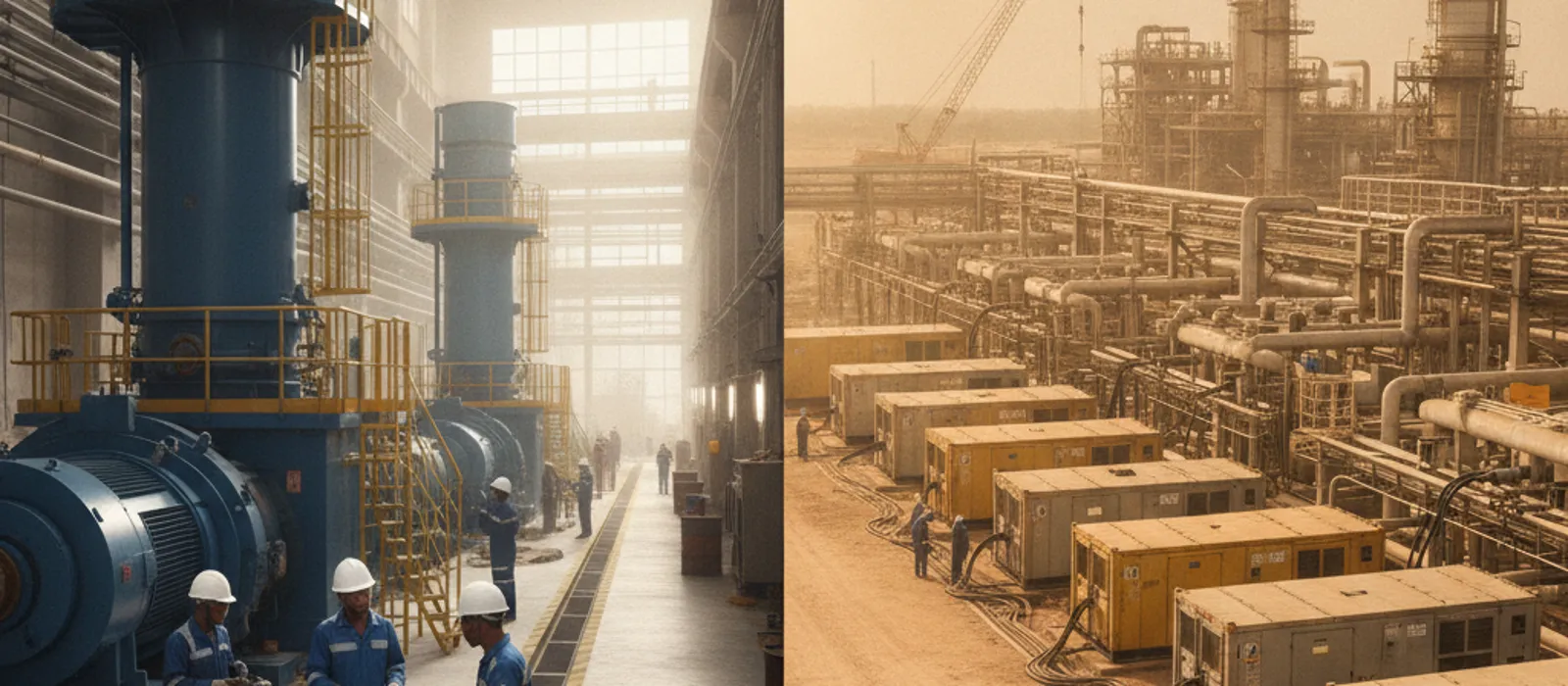
Picture a plant that runs generator hire for twenty two consecutive months, spending far more in cumulative hire charges than it would have spent on the installed cost of buying the same capacity, before anyone makes that comparison. Nobody makes a single bad decision. A run of small monthly approvals never gets escalated into a capital decision, and that is the most common way the generator rental vs purchase question in Nigeria gets answered badly.
The comparison itself is not difficult. It needs measured running hours, a delivered fuel price you can defend, an honest view of how long the load will exist, and a line for the risks that sit outside the hire rate. Most procurement files we review contain the monthly hire rate and the supplier’s purchase quotation and almost nothing else.
Diesel dominates the arithmetic in Nigeria. At a specific consumption around 0.27 litres per kWh at 75 percent load, fuel per kWh is 0.27 times your delivered diesel price, and that one line outweighs everything else in the comparison. Renting or buying changes the non-fuel portion of that number, not the fuel. Get the loading wrong and the ownership question becomes academic, which is why our breakdown of diesel generator cost per kWh is the better starting point if you have never metered your output.
What Actually Drives the Generator Rental vs Purchase Decision
Four variables settle it. Expected duration of the need, expected annual running hours, access to capital, and your ability to maintain the asset to a schedule once no hire company is responsible for it.
Duration is the crude first filter. Divide the fully installed purchase cost by the monthly dry hire rate and you get a breakeven in months, before maintenance obligations and residual value are considered. Run that division on your own quotes, because the result depends entirely on the rates you have been offered.
Running hours decide whether ownership is worth the management burden at all. A set covering 250 to 400 hours a year of genuine emergency standby rarely justifies a maintenance contract and an overhaul reserve. A set running 3,000 hours a year is a production asset and has to be resourced as one, with a spares holding, an oil analysis programme and a scheduled outage window.
The fourth variable is the one procurement cannot price and operations usually can. If you do not have the discipline to change oil on hours rather than on convenience, ownership will cost you more than the spreadsheet says. If you are unsure which side of these lines your plant sits on, request a technical proposal and we will run the comparison against your own load logs rather than a generic assumption.
When Renting Generating Capacity Is the Right Call
Rental earns its premium in four situations, and all four are about uncertainty rather than cash.
Short, defined outage cover. A transformer replacement, an 11 kV feeder rebuild, a substation cutover. You know the window, you know the load, and you need the capacity to leave site afterwards.
Unproven load. A new production line whose demand you have modelled but never measured. Hiring for the first six to nine months buys you a real load profile before you size a purchase, and both undersizing and oversizing a bought set are expensive. Our generator sizing guide sets out what to log before you commit capital.
Seasonal or campaign load. Milling seasons, cold chain peaks, harvest throughput. Owning enough plant to cover a ten week peak means carrying idle iron for the other forty two.
Bridging a lead time. If a bought set is sixteen to twenty weeks away and your existing engine is on borrowed time, hire is not a cost, it is insurance against the downtime that would otherwise land in that gap.
One caution on hired sets. Hire companies stock standard ratings, so what arrives is frequently larger than your load. A 500 kVA set carrying 120 kW will wet stack, glaze its bores and carbon its turbocharger inside a few hundred hours, and the fuel penalty is yours, not the hire company’s. Specify the rating you need and insist on it, or accept a documented load bank arrangement.
When Buying Generating Capacity Pays Back
Ownership wins where the load is stable, long lived and heavy. Above roughly 2,000 running hours a year with a horizon beyond three years, the arithmetic is rarely close.
Ownership also wins where the installation itself is the expensive part. Acoustic enclosure, a bunded bulk tank, exhaust routing above roof level and a synchronising panel are all sunk costs that a hire set cannot inherit. If you are building that infrastructure anyway, hiring the engine that sits inside it makes little sense.
There is a control argument too. An owned set can be specified for your fuel quality, your ambient temperature, your dust loading and your harmonic profile. Inland sites in Kano and Kaduna carry a real derating during harmattan, and radiator and filtration specification matters more there than the nameplate does. A hired set is whatever was on the yard that week.
Ownership carries obligations that must be funded from day one. A maintenance schedule tied to running hours, a spares holding for the items with the worst lead times, and an overhaul reserve. Our generator maintenance programmes exist because the failure mode after purchase is almost always a deferred service, not a bad machine.
Rental vs Purchase: Five Year Cost Comparison for a 500 kVA Set
The comparison below assumes a 500 kVA set at 400 kW prime rating, held at 75 percent load, running 3,000 hours a year for five years, 4.5 million kWh delivered. It uses 0.27 litres per kWh; price the fuel at your own delivered rate.
Two sets of costs make up each side of that comparison. Under rent: mobilisation and demobilisation, and a recurring hire charge that covers scheduled maintenance and consumables. Under buy: the set, canopy, ATS and base tank; the civils, exhaust and acoustic work to install it; scheduled maintenance and consumables that are now yours to fund; a top end overhaul reserve around the engine’s mid-life interval; and a residual value credit at the end of the period that offsets the total. Fuel is identical under either model since it depends on litres burned, not on who owns the machine.
Two readings come out of running that arithmetic with real numbers. At this duty ownership usually comes out ahead across five years, but the saving is a small share of the total, because fuel makes up the large majority of the spend under either model. A plant chasing the ownership saving while ignoring a 40 percent load factor is optimising the wrong line by a wide margin.
The residual value row is the one most often argued about. A well maintained set with a documented service history and a load bank record sells; one with a blank logbook does not. If you buy, treat the maintenance file as part of the asset. To have the ownership case modelled against your own hours and fuel logs, book a plant assessment.
Three Hypothetical Scenarios
Hypothetical example: an eight week transformer replacement with a measured peak of 560 kW. Hiring a 750 kVA set for the window costs a modest total against a purchase that would run to a large multiple of that for capacity the site would not need again. Rental is not the cheap option per month here, it is the only sensible one.
The plant from the opening example has a different profile. Two hired 350 kVA sets cover a 16 hour production day, six days a week, around 5,000 running hours a year. At that duty, cumulative hire charges pass the installed cost of a single larger set with a synchronising panel well before the second year is out. By month twenty two, when the file finally reaches the board, the hired sets are running at a combined 46 percent load, adding a real fuel penalty on top of a hire spend that has already run well past the breakeven point.
Hypothetical example: a hybrid arrangement, where an owned 250 kVA set carries the year round base load and a hired 200 kVA set covers an eleven week seasonal peak. Buying that second set outright would take many seasons to break even while it sits idle for nine months of the year and still needs exercise runs. Hybrid is frequently the right answer and is almost never the answer procurement starts with.
The Risks Procurement Usually Leaves Out of the Comparison
Spares lead time is the largest one. Injectors, turbochargers, AVRs and control cards for most industrial engines are imported, and sixteen to twenty four weeks from order to site is normal once foreign exchange approvals are in the chain. A hire contract transfers that exposure to the supplier. Ownership does not, unless you fund a critical spares holding at purchase, which typically adds five to eight percent to the capital cost.
Downtime cost is the second. If an hour of stopped production costs you more than the annual difference between hire and ownership, availability outranks unit cost and the comparison changes shape. Work out your own figure before you argue about hire rates, using the method in our plant downtime cost per hour article.
Compliance is the third. Captive generation above 1 MW requires a permit from the Nigerian Electricity Regulatory Commission, and the obligation follows the plant operator, not the hire company. Check the current position at nerc.gov.ng before you assume a hired set sits outside the regime. Bulk diesel storage and noise limits carry their own approvals depending on state.
Finally, be realistic about displacing diesel altogether. Solar PV with storage can cut daytime generator hours meaningfully for lighting, offices and steady auxiliary load, and Nigeria’s generation and access position is set out in the International Energy Agency country profile at iea.org. It will not carry a 400 kW process load through a night shift without a battery bank whose cost exceeds the generator several times over. Size any hybrid against a measured profile and a qualified engineer’s assessment of your switchgear, not against a headline payback figure.
Frequently Asked Questions
At what point does buying a generator become cheaper than hiring in Nigeria?
As a first cut, divide the fully installed purchase cost by the monthly dry hire rate. For most industrial ratings that lands between 24 and 30 months of continuous hire. Add maintenance and overhaul reserve and subtract residual value and the figure usually settles near 30 months, so any need you expect to run beyond two and a half years should be tested as a purchase.
Does the hire company cover maintenance and breakdowns?
It depends entirely on the contract, and this is where hire agreements differ most. Wet hire normally includes scheduled servicing, consumables and breakdown attendance within a stated response time, while dry hire may put routine servicing on you. Read the response time, the exclusions for fuel contamination and the liability for damage caused by your own switchgear before you sign.
How much does poor loading affect the rent or buy decision?
More than the decision itself does. A set running at 30 percent load burns roughly 0.33 to 0.38 litres per kWh against 0.27 at 75 percent, which is 25 to 40 percent more fuel for the same output. Since fuel is over 80 percent of the delivered cost, fixing load factor usually saves more than switching ownership model, and it also defers the next overhaul.
Can we hire first and buy later without wasting money?
Yes, and for an unproven load it is the disciplined approach. Hire for six to nine months, meter kWh and running hours throughout, then size the purchase from measured demand rather than connected load. Set a review date in the contract from day one so the hire does not roll on unexamined, which is exactly how plants drift past breakeven without a decision ever being taken.