
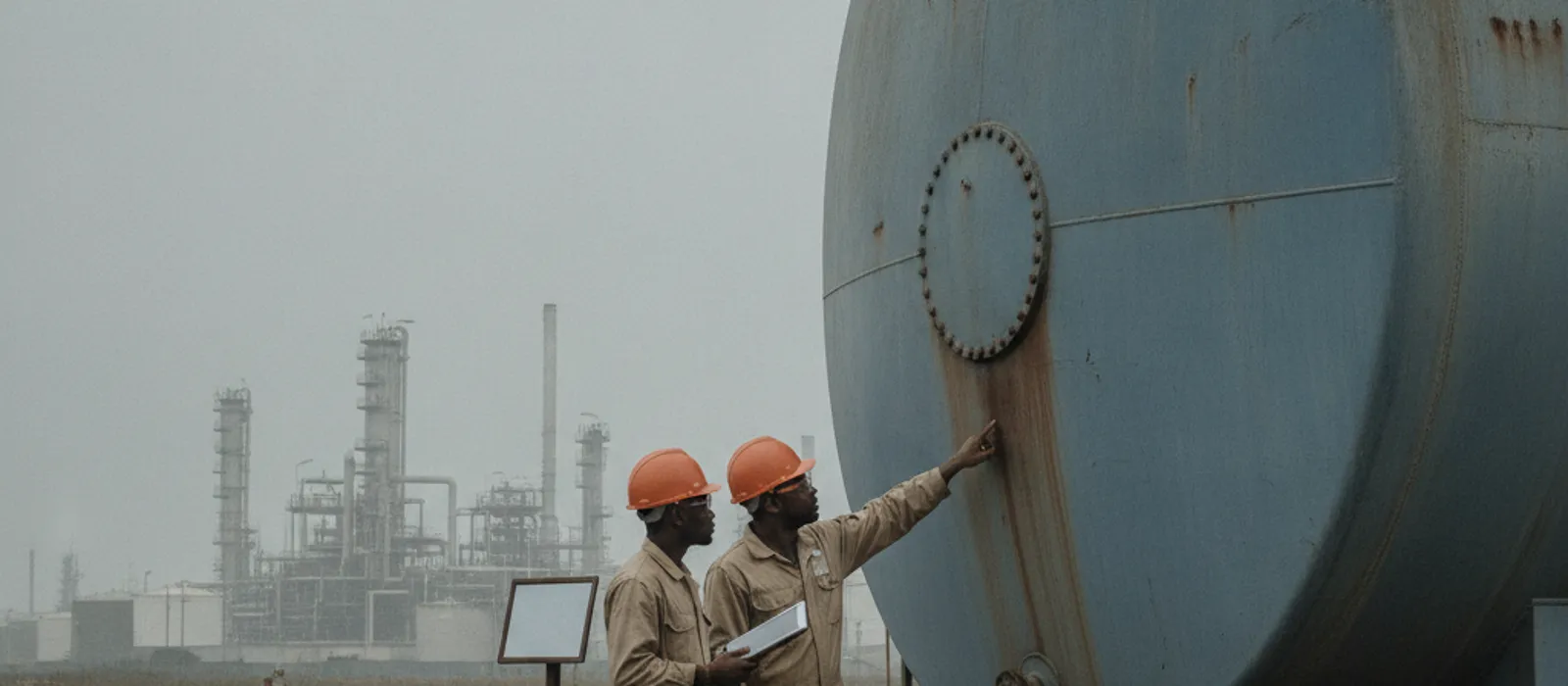
Picture a plant that spends a substantial sum on a 33,000 litre bulk diesel tank, transfer pumps, pipework and a cast bund, then stares at an empty tank for five months. The bund wall stands four metres from the site boundary, the vent discharges under a loading canopy, and the fire service will not sign. Diesel storage tank approval in Nigeria is not paperwork you chase after construction. It is a design input that fixes where the tank sits, how the bund is built and whether your sets have fuel on the day you planned to commission.
The failure pattern is consistent. The tank is treated as a procurement line, ordered on capacity and price, and dropped into a yard corner that nobody surveyed against separation distances. By the time a regulator walks the site, the concrete has cured and the only remedy is demolition.
This article sets out what triggers approval, who issues what, the siting and fire requirements that decide pass or fail, and indicative costs. Fee schedules and thresholds are revised, so confirm current figures with the regulator before a number goes into a board paper.
What triggers a diesel storage tank approval in Nigeria
Two beliefs cause most of the trouble. The first is that fuel held for your own use is unregulated. The second is that anything under some half remembered capacity threshold needs nothing at all.
Neither holds. Storage of automotive gas oil for self consumption is a consumer installation, and consumer installations sit inside the downstream licensing regime administered by the Nigerian Midstream and Downstream Petroleum Regulatory Authority under the Petroleum Industry Act 2021. Capacity thresholds, application formats and fees change, so work from current published guidance rather than a figure a contractor quoted three years ago.
In practice the trigger points are these:
- Bulk storage beyond the sub-base tank supplied with the generator. Once you install a separate tank with its own fill point, you have built a storage facility.
- Any tank served by road tanker. Discharge is the highest risk operation on the site and it draws fire service scrutiny regardless of capacity.
- Underground tanks, without exception. Buried steel creates soil and groundwater liability, and the environmental regulators treat it that way.
- Anything that changes the built footprint. A bund, plinth or pump house is a structure and needs planning permission like any other structure.
Even a 2,500 litre day tank inside a generator hall is inspectable. It will not usually need a construction licence, but it will need a flame arrester, containment, correct vent routing and an extinguisher regime, and the fire service can write it up.
If you are scoping a new generator hall or expanding an existing one, request a technical proposal before the civil drawings are frozen. Moving a tank on a drawing costs nothing. Moving it after the bund is cast costs weeks and a second mobilisation.
Who regulates bulk diesel storage, and what each body wants
Four or five authorities touch the same tank, and they do not coordinate on your behalf.
NMDPRA. Approval to construct, then a licence to operate once the built facility passes inspection. This is the federal instrument that makes the storage lawful. Current downstream licensing categories are published at nmdpra.gov.ng.
Fire service. Federal Fire Service or the state service, depending on where you sit. Lagos, Rivers and Kano all run active state fire authorities. They inspect siting, tanker access, extinguishing provision, earthing and signage, then issue the fire safety certificate.
Environmental regulators. NESREA at federal level plus the state agency, for example LASEPA in Lagos or the state ministry of environment elsewhere. Their interest is bund integrity, oily water discharge, soil contamination and waste oil handling. The applicable regulations are published at nesrea.gov.ng. Larger installations can also fall under environmental impact assessment requirements.
Physical planning. The state planning authority permits the civil works. Without it the other files stall, because no one will certify a structure that has no planning cover.
COREN. Layout, foundation and bund drawings should be prepared and stamped by an engineer registered with the Council for the Regulation of Engineering in Nigeria. Unstamped sketches are a routine rejection.
These run partly in sequence, not in parallel. Planning normally has to land before the environmental and fire files can close, and the operating licence depends on a physical inspection of finished work.
Siting rules that decide whether the tank passes
Diesel behaves differently from petrol and the codes reflect that. Under NFPA 30, a liquid with a flash point at or above 37.8 degrees C falls into the combustible classes rather than the flammable class, and typical AGO flashes well above that. This is why separation distances for diesel are less severe than for PMS. It is not a licence to crowd the fence line, and it stops applying if your fuel is cross contaminated with petrol, which drops the flash point sharply.
The clearances challenged most often are:
- Tank shell to site boundary, or to any building you do not control.
- Tank to the generator hall, including the exhaust run and turbocharger casings, which are live ignition sources at full load.
- Fill point to drains, manholes and open channels. A spill must not be able to reach a public drain.
- Tanker standing position to overhead lines, switchgear and the transformer yard.
Exact figures depend on capacity, tank type, whether the tank is bunded or self bunded, and what sits on the other side of your wall. A 20,000 litre self bunded skid against a warehouse gable is a different case from an open horizontal tank facing a residential street. Do not lift a dimension from another site’s drawing and assume it transfers.
Bunding is where projects lose the most money. The working rule is containment of 110 per cent of the largest tank in the bund, with an impermeable floor and walls, no gravity through drain, and a sump emptied under control. Where a bund holds more than one tank the calculation changes, and it has to be shown on the drawing rather than asserted in a cover letter.
Ground conditions matter more than people expect in Lagos, Port Harcourt and Warri. Reclaimed and waterlogged ground settles under a full tank, and a settlement crack in a bund floor is a straight failure of containment, so a piled or heavily reinforced raft is often unavoidable. For buried tanks a high water table brings buoyancy: an empty tank can float and shear its pipework, so anchor straps and a deadman slab are not optional extras. Confirming this needs a geotechnical investigation on the actual footprint, not an assumption from the plot next door.
One last item that plant managers forget. Check that a 33,000 litre tanker can enter, stand, discharge and leave without reversing across a live yard. Access is a fire requirement as well as an operational one.
Fire safety requirements the inspector will actually check
The inspection is more predictable than most people expect. The recurring items are:
- Flame arrester on the vent, with the vent terminating in open air clear of canopies, windows, air intakes and any walkway.
- Overfill prevention: a contents gauge, a high level alarm audible at the discharge point, and a written discharge procedure. Overfill during tanker delivery is the single most common spill event on Nigerian sites.
- Earthing and bonding, including a bonding cable and clamp used before the hose is coupled. Static during discharge is a real ignition mechanism, not a formality.
- An emergency shut off that isolates the tank outlet from outside the bund, plus a clearly labelled stop for the transfer pumps.
- Fire fighting provision sized to the installation, typically dry powder units at the fill point and pump skid, with foam capability considered for a bund fire on larger tanks.
- Signage, no smoking control, and a hot work permit system covering the tank area.
Construction and commissioning records carry equal weight. Expect to produce mill certificates for the plate, weld inspection records, a hydrostatic test certificate, a coating holiday test for buried tanks, and evidence of cathodic protection where the tank is in the ground. A tank with no test file is difficult to licence even when it is physically sound.
Do not neglect the low point. Specify a water draw off at the tank sump and a sampling point, because condensate and microbial growth in warm humid storage is what eventually reaches your injectors. The damage mechanism is covered in contaminated diesel and generator damage, and it is a maintenance issue that starts at the tank rather than at the engine.
To have the siting, bunding and fire provision reviewed against your actual plot before you build, book a plant assessment. Our generator maintenance service covers fuel systems from the tank through to the day tank and filtration.
Tank options, indicative costs and approval burden
The options below vary widely in installed cost and approval burden; treat the ranking as directional rather than a quote, and note they exclude the fuel itself, regulatory fees and any piling required by ground conditions.
| Storage option | Typical capacity | Approval burden |
|---|---|---|
| Sub-base tank under the genset | 500 to 2,000 litres | Fire inspection only, usually within the set supply |
| Self bunded skid tank, above ground | 10,000 litres | Construction and operating licence, no site bund needed |
| Site built horizontal tank with concrete bund | 33,000 litres | Full package: planning, construction licence, environmental, fire |
| Underground steel tank with anchors and CP | 45,000 litres | Heaviest: adds geotechnical work, leak detection and soil liability |
| Regulatory package: drawings, environmental report, fees, expediting | n/a | Runs across all bulk options |
The comparison that changes decisions is rarely the tank price alone. At an assumed AGO price of N1,250 per litre (use your own delivered price), filling a 33,000 litre tank can cost more than the tank and civils together. Bulk storage is as much a working capital decision as an engineering one, and it only pays back if your delivered price per litre improves enough to service that capital.
Hypothetical example one: a facility running two shifts. A 250 kVA standby set drawing roughly 38 litres per hour at 75 per cent load, with a 5,000 litre above ground tank giving about 130 hours of autonomy. The build is sound but the vent has been routed into a covered walkway, and the fill point sits two metres from a storm drain with no kerb. Remedial work to correct both takes about eleven days and costs a small fraction of what the original installation cost. Neither fault would have survived a pre-construction review.
Hypothetical example two: a plant running two 1,250 kVA sets in prime duty, burning close to 200 litres per hour each at typical load. The original design is a single 45,000 litre underground tank. Suppose the water table comes up at 1.6 metres in the geotechnical report, meaning anchor slabs, buoyancy calculations and a leak detection scheme, and pushing the environmental file into a longer review. Switching to three 15,000 litre self bunded skids saves on civils cost and cuts approval time by around nine weeks, at the cost of a larger footprint and three fill points to manage. For a plant where downtime is expensive, that trade is straightforward, and plant downtime cost per hour is the figure that decides it.
Sequencing a diesel storage tank approval without losing the outage window
Approvals fail on sequence more often than on substance. A workable order is: site survey and geotechnical investigation, then layout and bund design stamped by a registered engineer, then planning permit, then the environmental submission, then approval to construct. Build, test and document, then request inspection, then the operating licence, then first fill.
Allow twelve to twenty four weeks from a clean start for a bulk installation, longer where land title is unclear or the state agency has a queue. Tank fabrication and delivery run in parallel, but do not let a completed tank sit on site as pressure to start pouring concrete.
The rejections that come back most often are avoidable ones: tank shell too close to a boundary, no bund volume calculation on the drawing, vent terminating under cover, fill point without spill containment, no tanker turning circle, unstamped drawings and a missing hydrotest certificate. Fix these on paper and the inspection becomes a formality.
Two more points on programme. If the tank serves a captive plant, the storage file runs alongside the generation permit and the two share the same environmental evidence, which is set out in captive power permits in Nigeria. And if the tank is part of a wider fuel or plant efficiency review, a measured power plant audit will tell you whether the storage volume you are about to build is the right one.
To scope siting, bunding, fire provision and the approval sequence for your site, request a technical proposal.
Frequently Asked Questions
Do I need approval if the diesel is only for my own generators?
Yes. Storage for self consumption is treated as a consumer installation and still falls inside the downstream regulatory regime, alongside fire and environmental requirements. The generator’s integral sub-base tank is generally covered by the set supply, but a separate bulk tank with its own fill point is a storage facility. Confirm the current capacity thresholds with NMDPRA, because they are revised from time to time.
How long does a diesel storage tank approval take in Nigeria?
For a bulk installation, budget twelve to twenty four weeks from a clean start, assuming clear land title and complete drawings. Planning permission usually has to land before the environmental and fire files can close, and the operating licence depends on physical inspection of finished work. Sites with title disputes, queued state agencies or drawings that need rework routinely take longer.
Can I install an underground diesel tank where the water table is high?
It can be done, but it needs engineering rather than assumption. A high water table introduces buoyancy, so an empty tank can float and shear its pipework, which means anchor straps, a deadman slab and a verified buoyancy calculation. You will also need corrosion protection, leak detection and a geotechnical report on the actual footprint. In many coastal and delta locations a self bunded above ground tank is faster to approve and cheaper to insure against liability.
What bund volume do I need for a 33,000 litre tank?
The working rule is 110 per cent of the largest tank in the bund, so roughly 36,300 litres of net containment for a single 33,000 litre tank. Net means after deducting the volume the tank itself occupies inside the bund, which is a point applicants often miss. Where several tanks share a bund the calculation changes, and it must be shown on the stamped drawing rather than stated in a covering letter.