
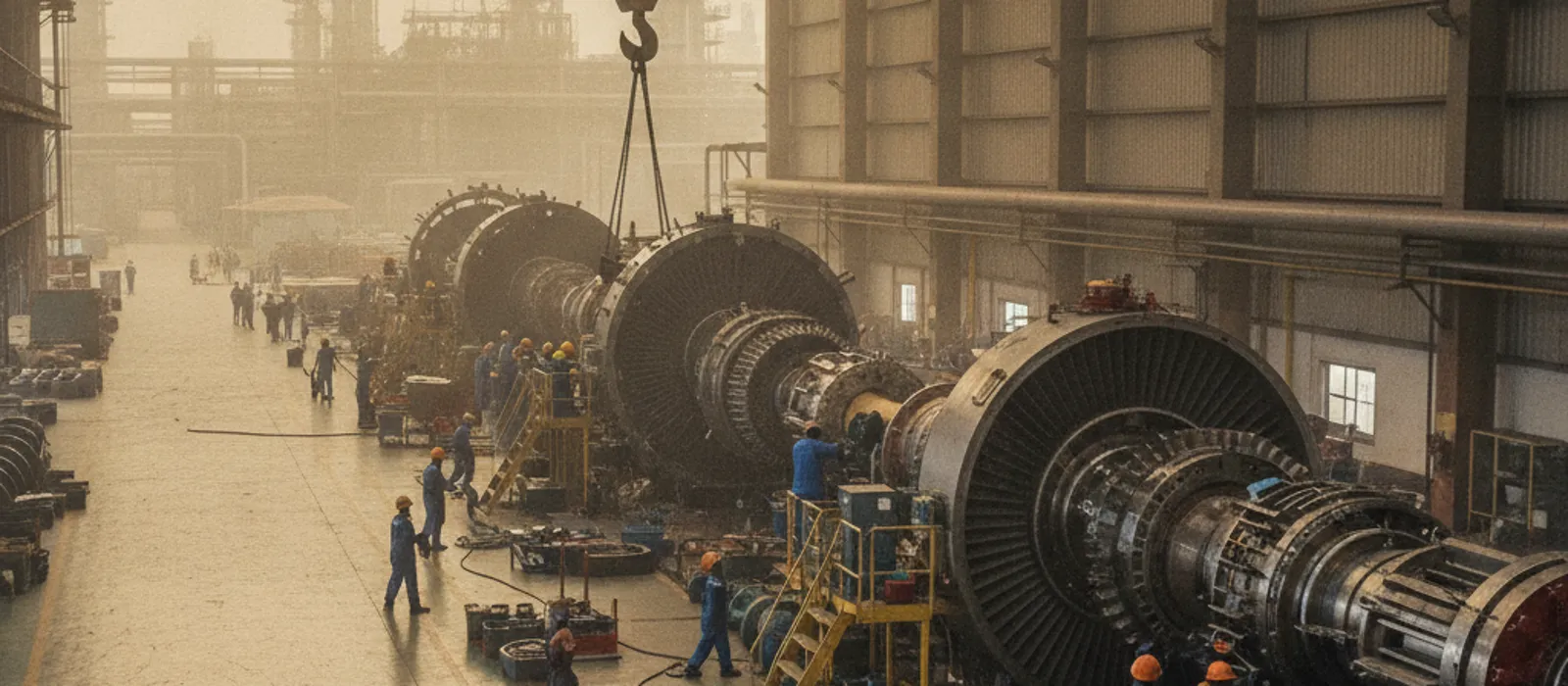
Three bids land on your desk for what is supposed to be the same hot gas path inspection, and the totals are nowhere close to each other. That spread is rarely competition. It is three contractors reading your enquiry three different ways, because the turbine overhaul scope of work you issued left room to guess.
That guessing gets settled later, on site, with the casing open and the plant down, when you have no leverage and the meter is running. A document that takes two weeks to write is the cheapest risk control on a job this size.
Why a vague turbine overhaul scope of work costs you twice
A weak scope produces two losses. The first is the variation order, priced without competition once the machine is in pieces. The second is the outage extension, which is almost always the larger number.
Worked example (hypothetical): take a 9 MW gas turbine in simple cycle, with grid supply as a partial fallback. An eleven day overrun, caused by nozzle segments that were never clearly in or out of scope, stacks downtime cost on top of unpriced parts. On a job of that size, the contract can end up close to double its original value without a single line of the original price changing.
The fix is not a longer document. It is a document that answers, for every component, three questions: what is being done to it, what number proves it is acceptable, and who signs before the job moves on.
If you are heading into an outage window this quarter and the specification is still a one-page enquiry, request a technical proposal and have the scope written before you go to market, not after.
The clauses your turbine overhaul scope of work must carry
Treat the following as the minimum content set. Anything missing becomes a negotiation you will lose on site.
1. Battery limits and boundary of supply. State exactly where the contractor’s work starts and stops: coupling to gearbox, generator terminals, inlet flange, exhaust expansion joint, lube oil skid, control cubicle. Name who supplies scaffolding, cranage, site power, lighting, welding gas, consumables and waste disposal. These items alone can move a bid by 20 to 30 percent.
2. Baseline condition and pre-outage data. Require the contractor to review your operating history before pricing: running hours, equivalent operating hours, start counts, trip history, vibration trends, exhaust spread, lube oil analysis. If you have unresolved trips, resolve the diagnosis first. Our note on gas turbine trip causes covers the patterns worth pulling out of the log before you write the scope.
3. Work breakdown by component. Do not write “overhaul the turbine”. Write it component by component: rotor, combustion system, hot gas path, bearings and seals, casing, valves and actuators, lube oil system, control and protection, generator and auxiliaries. Under each, state inspect, repair, refurbish, replace or exclude.
4. Acceptance criteria in numbers. This is the clause that separates a specification from a wish list. Rotor runout limits, bearing clearances, seal clearances, shaft alignment tolerance, balance grade, vibration acceptance at rated speed, insulation resistance and polarisation index for the generator, hydrostatic test pressures. Reference the applicable code instead of paraphrasing it. The ASME code and standards catalogue is the right anchor for turbine performance and pressure boundary work: https://www.asme.org/codes-standards
5. Non-destructive testing scope. State the method, the coverage and the standard for each item: magnetic particle, dye penetrant, ultrasonic, eddy current, borescope. Say whether coverage is 100 percent or sampled, and what happens when an indication is found. “NDT as required” is not a scope line.
6. Parts clause. Specify new, OEM-spec, reverse-engineered or reclaimed for each part class, and who decides. State that removed parts remain your property and must be returned in labelled crates. Require a reclaim versus replace recommendation in writing, with measured wear figures attached, before any decision is taken.
7. Schedule with a critical path. Ask for a resourced bar chart tied to your outage window, showing disassembly, inspection, decision gate, repair, reassembly, alignment, commissioning and load test. The decision gate after inspection is the item most bidders leave out, and it is where outages are lost.
8. Testing and handover. Define mechanical run, load steps, vibration signature at each step, protection function test and the performance datum the machine must meet. List the documentation deliverables: as-found and as-left clearance records, NDT reports, balancing certificates, alignment records and a final report.
9. Variation procedure. Agree unit rates and a labour day rate at bid stage, so that unknown-condition work is priced against a schedule you already accepted rather than against your desperation on day nineteen.
Hold points and witness points: where the scope gets teeth
A hold point stops work. The contractor may not proceed past it until your representative signs. A witness point invites you to attend, but work continues if you do not turn up within the notice period. A review point is document only. Mixing these three is the most common drafting error we see in Nigerian plant contracts.
Set the notice period explicitly, normally 48 hours for site hold points and 10 working days for shop or overseas witness points. State who holds signing authority and name the deputy, because the outage will not pause because one engineer travelled.
A workable minimum set of hold points for a gas turbine major inspection:
- After disassembly, before any cleaning: as-found photographs, clearances and deposit condition recorded.
- After cleaning and NDT of rotor, blades and nozzles, before any repair decision.
- Blade root and disc dovetail inspection results, before rotor is released for balancing.
- Balancing certificate and residual unbalance record, before rotor is installed.
- As-left clearance record and foreign object search, before casing closure.
- Final alignment record, before coupling is bolted up.
- Protection and trip function test results, before first fire.
The casing closure hold point is the one to defend hardest. Once the top half is down, a missed clearance or a tool left in the flow path costs a second outage, and the second outage is never cheaper than the first.
Hypothetical example: a 6 MW back pressure steam turbine on a mid-life overhaul. Suppose casing closure goes ahead over a weekend with no client sign-off, and vibration at 3,000 rpm comes up at 7.8 mm/s rms against an acceptance limit of 4.5. The strip and re-shim would cost a second outage on top of the first, and a signed clearance sheet would have caught the bearing pedestal shim error in an afternoon.
Hold points only work if a competent person is present to exercise them. If you do not have a rotating equipment engineer free for the duration, appoint one, either from your own staff or as an owner’s engineer on the contract. Book a plant assessment if you need an independent pair of eyes to sit on the hold points during your window.
Spares, long-lead items and the parts clause
In Nigeria the parts clause decides the schedule more often than the labour does. Hot gas path components, journal and thrust bearings, diaphragms, control valve internals and generator wedges are frequently 16 to 30 weeks from order, and that is before clearing. Add Form M processing, PAAR issuance and port clearance, and a part ordered after the machine is opened will not make your outage window.
Three practical rules:
Pre-inspect, then pre-order. Run a borescope inspection and condition assessment three to six months ahead, then order the parts the assessment says are probable, not merely possible. This is the highest-return decision in outage planning.
Define the reclaim boundary. State the wear limits beyond which a part is scrapped rather than repaired, so the decision is not made under schedule pressure. Weld repair of blade tips, nozzle segment reclaim and journal re-metalling are all legitimate, but each has a limit that should be written down before the outage.
Price the risk parts as provisional sums with firm rates. A provisional sum with no agreed rate is a blank cheque. A provisional sum with a fixed unit rate and a fixed delivery commitment is a managed risk.
Condition assessment intervals matter here too. If you are unsure whether your machine is due, our guidance on turbine inspection intervals sets out the hours-based and starts-based triggers. If the assessment comes back poor across the hot section, the honest question may be whether to overhaul at all, which we cover in turbine overhaul vs replacement.
Comparing overhaul bids on the same basis
You cannot compare lump sums. You compare normalised totals: bid price, plus the value of scope the bidder pushed back to you, plus the cost of the outage days each bidder needs.
Here is a real-shape comparison, hypothetical, for two 5.5 MW gas turbines, with downtime valued using the plant’s own cost per day (our downtime cost guide sets out how to build that figure).
| Scope line | Bid A | Bid B | What to check before comparing |
|---|---|---|---|
| Headline lump sum | Lower headline price | Higher headline price | Lowest number rarely survives normalisation |
| Rotor NDT | Sampled, method unstated | 100 percent MPI and UT, standard cited | Coverage and method, not the word “NDT” |
| Hot gas path parts | Provisional sum, no rates stated | Firm sum, OEM-spec nozzles | Provisional with no rate is unpriced risk |
| Rotor balancing | Field balance only | Low speed shop balance to G2.5 | Field balance cannot fix a bent rotor |
| Generator overhaul | Excluded | Included, winding tests and PI | Excluded scope returns as a second contract |
| Scaffolding, cranage, site power | Client scope | Contractor scope | Price your own scope back in before comparing |
| Quoted outage duration | 34 days | 26 days | 8 day delta, priced at your own downtime cost per day |
| Liquidated damages | Not stated | 0.5 percent per day, 5 percent cap | No LDs means schedule is your risk |
| Warranty | 6 months from handover | 12 months or 8,000 EOH, whichever first | EOH terms suit machines that run hard |
| Normalised total | Higher once normalised | Lower once normalised | Normalisation can reverse the headline ranking |
The headline gap favoured Bid A. Once scope, coverage and outage days were normalised onto the same basis, Bid B came out lower overall. Nothing in that reversal required technical judgement, only a scope written well enough to expose the differences.
Build this table before the bids arrive, with the rows fixed by a mandatory pricing schedule in the enquiry. Bidders who will not price it line by line are telling you something useful.
Commercial terms that decide who carries the risk
Tie payment milestones to hold point sign-offs, not to calendar dates. A milestone that pays on “60 percent completion” invites argument. A milestone that pays on signed as-left clearance records pays for a verified event.
Set liquidated damages against the outage window, not the total contract duration, and calibrate the daily rate against your real downtime cost rather than a token percentage. Keep retention of 5 to 10 percent through the warranty period, released on a defined performance datum.
State a performance guarantee only where you can measure it. Output and heat rate at reference ambient conditions are measurable if you have the instrumentation and an agreed test procedure. If you do not, say so in the scope and agree a simpler mechanical acceptance instead of writing a guarantee nobody can enforce.
Two points specific to Nigerian sites. Ambient temperature, altitude and inlet filtration condition all affect the output you can hold a contractor to, so reference conditions must sit inside the test clause. And if the machine forms part of a captive or embedded generation arrangement, confirm your licensing position with the Nigerian Electricity Regulatory Commission before the outage, since a permit review is easier while the machine is down: https://nerc.gov.ng/
Scope, hold points and commercial terms are one system: written together they give you a contract that prices fairly and finishes on time, and written separately they give you a dispute.
For a scope drafted against your machine history, outage window and downtime cost, request a technical proposal. We also execute the work through steam turbine overhaul and rotating equipment services, with budget shape covered in our maintenance cost guidance.
Frequently Asked Questions
How long should a turbine overhaul scope of work be?
For a major inspection on a mid-size industrial machine, expect 25 to 60 pages including the pricing schedule, hold point register and acceptance criteria tables. Length is not the measure of quality, but a scope under ten pages almost never carries enough numbers to be enforceable. What matters is that every component has a stated action, a numeric acceptance criterion and a named sign-off authority.
Should the plant or the contractor write the scope?
The plant should own the scope, using its own engineer or an independent owner’s engineer. A contractor-written scope will naturally be shaped around what that contractor is set up to deliver, which makes competitive comparison impossible. It is reasonable to ask bidders to propose additions during the tender query period, provided every bidder then prices the same amended document.
What are the minimum hold points for a gas turbine major inspection?
At minimum: as-found condition record after disassembly, NDT results before any repair decision, balancing certificate before rotor installation, as-left clearance record before casing closure, final alignment record before coupling, and protection function test before first fire. Each needs a defined notice period and a named signatory with a deputy. Casing closure is the hold point never to waive, because reopening costs a second outage.
Is a lump sum better than a schedule of rates?
A lump sum works when condition is well understood from a recent borescope and vibration assessment, since the contractor can price the risk fairly. Where condition is unknown, a lump sum for the known work plus an agreed schedule of rates for discovered work usually lands cheaper, because bidders stop pricing worst-case contingency into the base. Either way, agree the day rates and unit rates at bid stage rather than during the outage.