
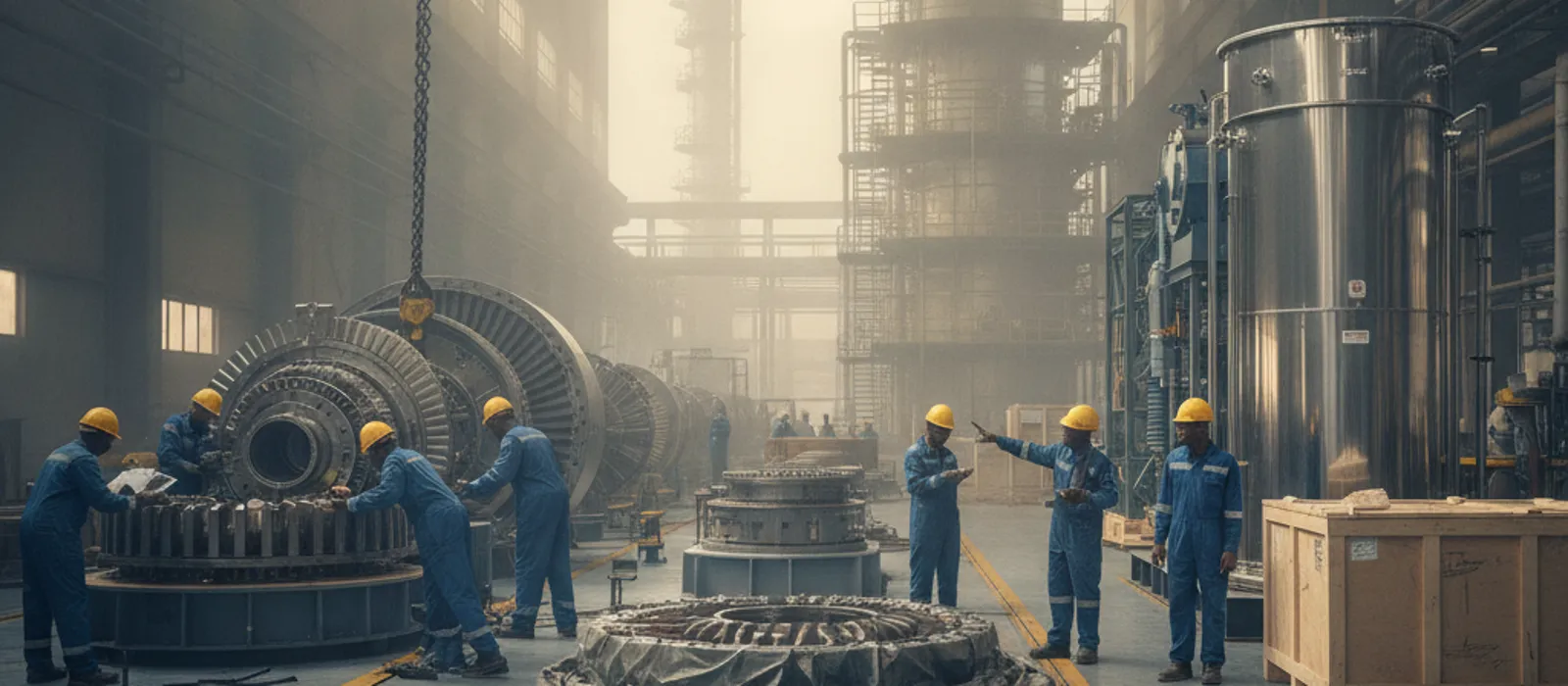
A 6 MW industrial gas turbine trips on high exhaust temperature spread at 2am. By the time the covers come off you are looking at a burnt through transition piece, first stage tip rub and a rotor that needs to leave site. The repair quote lands at a fraction of what a comparable new package would cost, and the same week a vendor offers that new package on the promise of roughly 14 per cent less gas burn.
That is the moment turbine overhaul or replace stops being an engineering argument and becomes a cash flow question. The machine will still make power after either decision. What separates the two options is where the money sits on the calendar, how many days the plant is down, and what you pay for fuel every hour for the next decade.
Build the comparison against your own gas or diesel contract price and your own commercial borrowing rate, because those two inputs move the answer more than anything an engineer will tell you about blade condition.
The Real Question Behind Turbine Overhaul or Replace
Most plants ask the wrong question first. They ask what the overhaul costs, compare it to a new unit price, see a number four or five times smaller, and stop there. That comparison is close to meaningless because it puts a one off repair next to a whole installed plant and ignores the running cost that dwarfs both.
The question that matters is total cost of ownership across a defined horizon, usually ten years for rotating plant of this class. Over ten years at 7,200 running hours a year, fuel typically accounts for 75 to 85 per cent of the money that leaves your account. Capital cost, spares and outage losses share what is left.
A degraded turbine that has been overhauled twice does not come back to nameplate heat rate. Compressor fouling that has been polished out returns, hot section clearances open up again, and a machine that left the factory at 11.5 MJ/kWh may settle at 13.5 to 14.0 MJ/kWh after two majors. That gap is small on a datasheet and very large on a ten year gas bill.
If you are at this decision point now, request a technical proposal and we will build the comparison against your actual fuel contract, load profile and outage constraints rather than a generic model.
Building the Ten Year Cost Model in Naira
Six cost lines carry almost all the weight. Get these right and the decision usually makes itself.
Capital outlay and its timing. An overhaul is spent once, now, while a replacement is spent once at four to six times the size and often needs a facility or lease structure carrying its own interest cost. Include that interest: financed at a Nigerian commercial rate, it can add a substantial fraction of the capital sum across the term, so price it explicitly rather than leaving it off the comparison.
Fuel or heat rate. Convert heat rate into naira per year at your contract price, and do not accept an OEM figure at face value. Datasheet heat rates are quoted at ISO conditions of 15°C, sea level and clean inlet air, so at 33°C ambient in Lagos or Kano you will lose output and give back part of the efficiency gain. Dust loading during harmattan compounds this, which is covered in our note on harmattan dust and turbine derating.
Planned outage days. Price a day of downtime properly. For most industrial sites the number is not lost production, it is the cost of running the diesel standby fleet instead of the turbine, and that delta can run to a significant daily figure for a mid sized plant. Build it from your own standby fuel burn and diesel price rather than a rule of thumb.
Unplanned outage exposure. An older machine trips more. Assign a realistic annual figure based on your own trip log, not on optimism.
Spares, consumables and inspections. Combustion inspections, hot gas path inspections, filters, lube oil, borescope campaigns and vibration monitoring. Our guidance on turbine inspection intervals sets out where these fall in a typical cycle.
Residual value and obsolescence. If parts for your frame are already on extended lead times or the OEM has moved the model to legacy support, that risk belongs in the model as a hard cost, not a footnote.
Overhaul or Replacement: A Worked Ten Year Comparison
Worked example (hypothetical): the comparison below models a 6 MW industrial gas turbine in cogeneration service, 7,200 running hours a year at an average 4.8 MW load, at an assumed gas price of USD 8.00 per MMBtu (use your own contract price). Figures are illustrative and the pattern matters more than any single total.
Six lines carry the comparison. Under overhaul, the major event lands in year one with a second major around year seven; under replacement, the installed package lands in year one with a hot gas path inspection around year eight. The assumed average heat rate is 13.9 MJ/kWh under overhaul against 11.9 MJ/kWh under replacement, which is the single biggest driver of the ten year fuel bill. Routine maintenance and spares run somewhat higher under overhaul because the older machine needs more attention. Planned outage days come to about 96 under overhaul against 62 under replacement, priced at your own standby fuel cost per day. Unplanned outage and standby fuel exposure is higher on the overhauled machine because it trips more as it ages.
Put your own capital cost, financing cost, fuel price and standby cost against each line and the ten year totals can land surprisingly close together. On a spreadsheet that closeness is not a tie-breaker, it is the point: with the two totals this close, the decision is not settled by the headline capital figures at all, but by three inputs: gas price, running hours and the heat rate you actually achieve. Every one of those is site specific.
Move gas price up and replacement wins by a clear margin. Drop running hours and overhaul wins outright, because the fuel saving no longer has enough hours to repay the extra capital.
Hypothetical Scenarios: Same Question, Different Answers
Hypothetical example: 6 MW gas turbine in cogeneration service, 7,200 hours a year. Take a machine matching the exhaust spread trip described at the top of this article. The overhaul quote comes with a 32 day outage if the rotor is sent away and reworked off site. Running the diesel fleet through that window at a realistic standby fuel delta means the outage alone can carry a cost close to the size of the repair quote itself, a cost that never appears on the repair quote.
Suppose the plant chooses overhaul but changes the scope: rather than sending the rotor away and waiting, it takes a rotor exchange, cutting the outage from 32 days to 13 days. The exchange rotor adds to the invoice, but the standby diesel saved over those extra 19 days is typically larger. That is a straightforward win that only becomes visible once downtime is priced properly.
Hypothetical example: 2.5 MW back pressure steam turbine on a biomass fired boiler, 8,000 hours a year, no gas connection so diesel standby only. At 61,000 running hours, suppose a borescope finds root cracking across four blade rows. Reblading and a full overhaul, with the rotor sent out for reblading and high speed balancing and no spare rotor on site, means a 46 day outage.
Forty six days of diesel standby at a realistic daily delta can exceed the overhaul cost itself. A complete new turbine generator set typically carries a lead time of around 14 weeks and a price several times the overhaul, so replacement is rarely the cheaper route in this scenario. The disciplined move is to overhaul, then hold a spare rotor so the next event is a short swap rather than a 46 day wait.
Hypothetical example: 1.5 MW unit used for peak shaving only, 2,400 hours a year. Low utilisation flattens the fuel argument almost completely. A 2 MJ/kWh heat rate improvement on so few running hours saves only a modest sum over ten years, nowhere near enough to justify replacement capital. Overhaul, keep the machine on a strict inspection regime, and spend the difference on the standby fleet instead.
The pattern across all three is the same. High running hours favour replacement, low running hours favour overhaul, and outage length is frequently worth more than the repair price. Book a plant assessment if you want these numbers built against your own load and fuel data.
When Replacement Beats Overhaul on a Ten Year View
There are conditions under which the calculation is no longer close and replacement is the correct engineering answer, not just the commercial one.
Casing or rotor forging damage that cannot be repaired to code is the clearest case. Once you are into a rotor with cracking beyond acceptance limits, a new bore, or a casing with through wall defects at a horizontal joint, the repair is neither cheap nor certain, and a repaired component of that kind carries residual risk for the rest of its life.
Parts obsolescence is the second. If lead times on hot section components have gone from 12 weeks to 40 weeks, you are no longer running a machine, you are running an inventory problem. Price that as extra spares holding, or accept that the outage risk has changed materially.
The third is a change in the plant itself. If your steam or electrical demand has shifted so the machine now runs at 40 per cent load most of the year, you are burning fuel at a punishing part load heat rate. Right sizing the unit can beat overhauling a machine that no longer matches the site, and the same logic applies when you are choosing between prime movers in the first place.
Be honest about what a new machine will not do. It will not remove the need for inspection intervals, it will not survive poor fuel gas conditioning or a neglected inlet filtration system, and its quoted efficiency will not hold at Nigerian ambient temperatures. A new turbine installed behind the same bad water treatment or the same dirty gas supply will degrade on the same curve as the one you replaced.
How to Run the Decision Without Guessing
Do not commit to either path on a visual inspection and a verbal quote. The sequence below is what a defensible decision looks like.
Start with condition assessment: borescope of the hot section and compressor, vibration data trended against ISO limits rather than a single snapshot, lube oil analysis, and clearance measurements where access allows. Vibration acceptance for machines in this class is set out in ISO 20816-2, and comparing your readings against a published zone boundary is far more useful than comparing them against last quarter.
Then establish the true heat rate from a plant performance test at stable load, not from the nameplate. A two or three point test at 60, 80 and 100 per cent load will show you the part load penalty you are actually paying.
Next, define the scope precisely so the quotes are comparable. Combustion inspection, hot gas path and major inspection are very different jobs, and vendors will price to different assumptions unless the scope is written down. Our breakdown of a turbine overhaul scope of work sets out what each level should include.
Finally, cost the outage window and check the regulatory position. If replacement changes your generation capacity or your captive arrangement, permitting sits with the Nigerian Electricity Regulatory Commission and lead times there belong in your project schedule.
Some of this needs specialist equipment and a qualified engineer on site. Rotor runout, clearance mapping and high speed balancing are not desk exercises, and a performance test is only meaningful with calibrated instrumentation and a stable load. Where site conditions prevent a full assessment, say so in the report rather than modelling around the gap.
For the full comparison work, see our steam turbine overhaul and power plant audit services, or the current cost bands in our generator and turbine maintenance cost guide. To start a condition assessment, request a technical proposal and we will scope the survey against your outage calendar.
Frequently Asked Questions
How many hours before a turbine needs a major overhaul?
For industrial gas turbines the common interval is 24,000 to 32,000 equivalent operating hours between majors, with combustion inspections around 8,000 hours and hot gas path inspections near the midpoint. Equivalent hours matter more than clock hours, because every start and every trip adds a factored penalty. Steam turbines in clean service often run longer, but water chemistry history changes that significantly. Your OEM manual and your own trip log should set the interval, not a rule of thumb.
Does a new turbine really deliver the efficiency the datasheet quotes?
Not at Nigerian site conditions. Datasheet heat rate is quoted at 15°C, sea level, clean inlet air and no inlet or exhaust pressure loss. At 32°C to 36°C ambient you will lose output and part of the efficiency gain, and inlet filter loading during harmattan pushes it further. Ask the vendor for a site rated performance curve at your ambient and altitude before you sign anything.
Can we overhaul a turbine in stages to spread the cost?
Sometimes, and it is worth asking. A combustion inspection followed by a hot gas path inspection at the next window is a legitimate way to split spend across two budget years, provided the borescope does not show damage that is progressing. What you cannot stage is rotor work, since the machine has to be open and the rotor removed either way. If the rotor is the problem, staging simply doubles the outage days.
How long is the outage for a major overhaul?
For a mid sized industrial gas turbine, budget 25 to 35 days on site for a major inspection with the rotor sent out, or 10 to 15 days if a rotor exchange is used. Steam turbine majors that require reblading and high speed balancing off site commonly run 40 to 50 days. Lead time on parts and rotor availability drives this far more than labour does, so confirm parts before you book the window.